Discussion
Loading...

Discussion

Log in
  • About
  • Code of conduct
  • Privacy
  • About Bonfire
Stan Carey
Stan Carey
@stancarey@mastodon.ie  ·  activity timestamp 6 days ago

Every morning now a mistle thrush (Turdus viscivorus) outside the window collects lichen, moss, and twigs like it's the last day of sales.

Today she had a tug-of-war with a string of living ivy that lasted a good 20 seconds. She won.

It's glorious to watch.

#birds #wildlife #Ireland #IrishWildlife #nature #thrushes #nests #spring

  • Copy link
  • Flag this post
  • Block
Stan Carey
Stan Carey
@stancarey@mastodon.ie  ·  activity timestamp 6 days ago

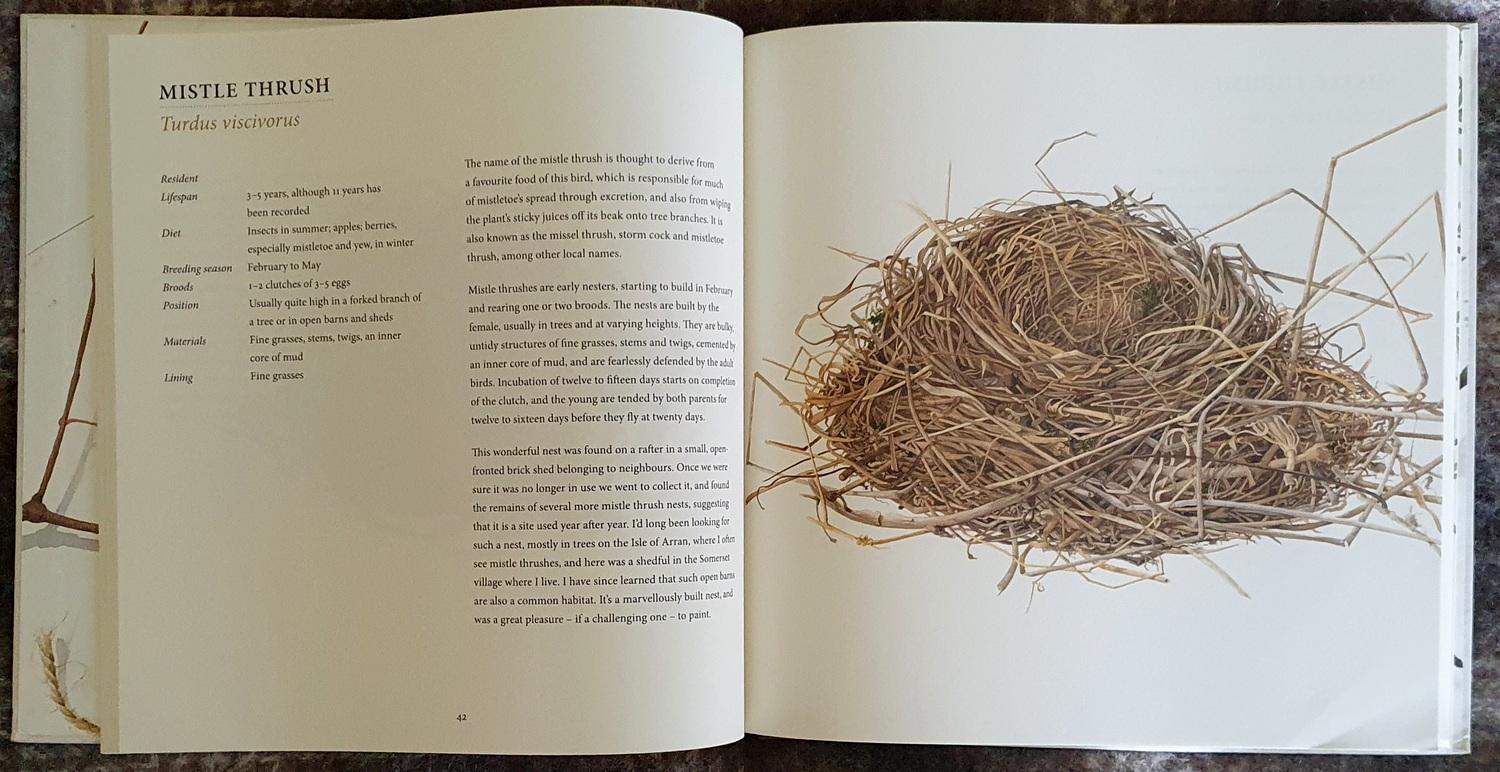
This is what a mistle thrush nest looks like. Text and painting by Susan Ogilvy, from her beautiful book "Nests"

#birds #books #painting #SusanOgilvy #art #NatureArt #BirdArt #nests #wildlife #thrushes #MistleThrush #spring

Right-hand page has a detailed, hand-drawn colour painting of a mistle thrush nest, shaped like a small hill with a hollow. Left-hand page has the following text:
MISTLE THRUSH. Turdus viscivorus. Resident.
Lifespan: 3–5 years, although 11 years has been recorded.
Diet: Insects in summer; apples; berries, especially mistletoe and yew, in winter.
Breeding season: February–May.
Broods: 1–2 clutches of 3–5 eggs.
Position: Usually quite high in a forked branch of a tree or in open barns and sheds.
Materials: Fine grasses, stems, twigs, an inner core of mud.
Lining: Fine grasses.
The name of the mistle thrush is thought to derive from the favourite food of this bird, which is responsible for much of mistletoe's spread through excretion, and also from wiping the plant's sticky juices off its beak onto tree branches. It is also known as the missel thrush, storm cock and mistletoe thrush, among other local names.
Mistle thrushes are early nesters, starting to build in February and rearing one or two broods. The nests are built by the female, usually in trees and at varying heights. They are bulky, untidy structures of fine grasses, stems and twigs, cemented by an inner core of mud, and are fearlessly defended by the adult birds. Incubation of 12–15 days starts on completion of the clutch, and the young are tended by both parents for 12–16 days before they fly at 20 days.
This wonderful nest was found on a rafter in a small, open-fronted brick shed belonging to neighbours...

Right-hand page has a detailed, hand-drawn colour painting of a mistle thrush nest, shaped like a small hill with a hollow. Left-hand page has the following text: MISTLE THRUSH. Turdus viscivorus. Resident. Lifespan: 3–5 years, although 11 years has been recorded. Diet: Insects in summer; apples; berries, especially mistletoe and yew, in winter. Breeding season: February–May. Broods: 1–2 clutches of 3–5 eggs. Position: Usually quite high in a forked branch of a tree or in open barns and sheds. Materials: Fine grasses, stems, twigs, an inner core of mud. Lining: Fine grasses. The name of the mistle thrush is thought to derive from the favourite food of this bird, which is responsible for much of mistletoe's spread through excretion, and also from wiping the plant's sticky juices off its beak onto tree branches. It is also known as the missel thrush, storm cock and mistletoe thrush, among other local names. Mistle thrushes are early nesters, starting to build in February and rearing one or two broods. The nests are built by the female, usually in trees and at varying heights. They are bulky, untidy structures of fine grasses, stems and twigs, cemented by an inner core of mud, and are fearlessly defended by the adult birds. Incubation of 12–15 days starts on completion of the clutch, and the young are tended by both parents for 12–16 days before they fly at 20 days. This wonderful nest was found on a rafter in a small, open-fronted brick shed belonging to neighbours...
  • Copy link
  • Flag this comment
  • Block

BT Free Social

BT Free is a non-profit organization founded by @ozoned@btfree.social . It's goal is for digital privacy rights, advocacy and consulting. This goal will be attained by hosting open platforms to allow others to seamlessly join the Fediverse on moderated instances or by helping others join the Fediverse.

BT Free Social: About · Code of conduct · Privacy ·
Bonfire social · 1.0.2-alpha.34 no JS en
Automatic federation enabled
Log in
Instance logo
  • Explore
  • About
  • Code of Conduct