Discussion
Loading...

#Tag

Log in
  • About
  • Code of conduct
  • Privacy
  • About Bonfire
Social Media Channel boosted
Miguel Afonso Caetano
@remixtures@tldr.nettime.org  ·  activity timestamp yesterday

"You’ve certainly experienced it: you grab your phone to do something specific, and end up getting lost in the maze of stimuli – sounds, colours, videos, notifications, urgent messages –so much so that you forget why you picked up the phone in the first place and stay far longer on it than planned. We keep inventing new words to describe aspects of the experience, whether it’s doomscrolling, internet rabbit holes, or brainrot. The good news is, this isn’t just something that happens to you. There’s a growing political consensus that this is a structural problem by design, that Big Tech has gone too far, and EU legislation is on the way to give you more control over addictive features in social media apps. The bad news is, Big Tech has begun a full scale lobbying battle against this legislation.

As the European Commission is preparing rules to rein in the addictive design of social media app –­ as part of the forthcoming Digital Fairness Act – the tech industry is drawing on its considerable lobbying firepower to oppose it. The legislation comes in response to growing concerns about the public health impacts of social media addiction, both for children, adolescents, and adults alike. But the Big Tech giants behind Facebook, Instagram, TikTok, Snapchat, and other social media apps are pushing back. Keeping people on the apps for as long as possible is a central part of their business model and restrictions in addictive features would hurt their profits and power. In its lobbying, Big Tech aims to capitalize on the fact that EU decision-makers – with Commission President von der Leyen in the lead – are currently heavily prioritising industrial competitiveness via deregulation over other concerns. This means there are major new obstacles for legislation to pass."

https://corporateeurope.org/en/2026/02/addicted-algorithm-how-big-tech-lobbies-keep-us-hooked-social-media

#SocialMedia #BigTech #EU #Lobbying #DFA #DigitalFairnessAct #Addiction #BrainRot

Corporate Europe Observatory

Addicted to the algorithm: how Big Tech lobbies to keep us hooked on social media | Corporate Europe Observatory

As the EU prepares the Digital Fairness Act to tackle the addictive nature of social media design, big tech aggressively protects its business models. With Trumpists and far-right allies likely to join the chorus against the DFA, the Commission’s own drive for deregulation at all costs is not helping the chances of strong legislation.
  • Copy link
  • Flag this post
  • Block
Miguel Afonso Caetano
@remixtures@tldr.nettime.org  ·  activity timestamp yesterday

"You’ve certainly experienced it: you grab your phone to do something specific, and end up getting lost in the maze of stimuli – sounds, colours, videos, notifications, urgent messages –so much so that you forget why you picked up the phone in the first place and stay far longer on it than planned. We keep inventing new words to describe aspects of the experience, whether it’s doomscrolling, internet rabbit holes, or brainrot. The good news is, this isn’t just something that happens to you. There’s a growing political consensus that this is a structural problem by design, that Big Tech has gone too far, and EU legislation is on the way to give you more control over addictive features in social media apps. The bad news is, Big Tech has begun a full scale lobbying battle against this legislation.

As the European Commission is preparing rules to rein in the addictive design of social media app –­ as part of the forthcoming Digital Fairness Act – the tech industry is drawing on its considerable lobbying firepower to oppose it. The legislation comes in response to growing concerns about the public health impacts of social media addiction, both for children, adolescents, and adults alike. But the Big Tech giants behind Facebook, Instagram, TikTok, Snapchat, and other social media apps are pushing back. Keeping people on the apps for as long as possible is a central part of their business model and restrictions in addictive features would hurt their profits and power. In its lobbying, Big Tech aims to capitalize on the fact that EU decision-makers – with Commission President von der Leyen in the lead – are currently heavily prioritising industrial competitiveness via deregulation over other concerns. This means there are major new obstacles for legislation to pass."

https://corporateeurope.org/en/2026/02/addicted-algorithm-how-big-tech-lobbies-keep-us-hooked-social-media

#SocialMedia #BigTech #EU #Lobbying #DFA #DigitalFairnessAct #Addiction #BrainRot

Corporate Europe Observatory

Addicted to the algorithm: how Big Tech lobbies to keep us hooked on social media | Corporate Europe Observatory

As the EU prepares the Digital Fairness Act to tackle the addictive nature of social media design, big tech aggressively protects its business models. With Trumpists and far-right allies likely to join the chorus against the DFA, the Commission’s own drive for deregulation at all costs is not helping the chances of strong legislation.
  • Copy link
  • Flag this post
  • Block
Corporate Europe Observatory
@corporateeurope@mstdn.social  ·  activity timestamp 2 days ago

The addictive design of social media is a major societal problem with serious impacts on public health & endangering the future of democracy

Weakening of the #DFA, in the name of 'simplification' or ‘competitiveness’, would only benefit the already excessively powerful US-based tech giants

Corporate Europe Observatory
@corporateeurope@mstdn.social replied  ·  activity timestamp 2 days ago

There’s a very unequal #lobbying battle ahead, between Big Tech with its massive lobbying budgets versus civil society groups with far less resources

But civil society has public opinion on its side and citizens, increasingly fed up with Big Tech, are getting organised

Its time to get involved!

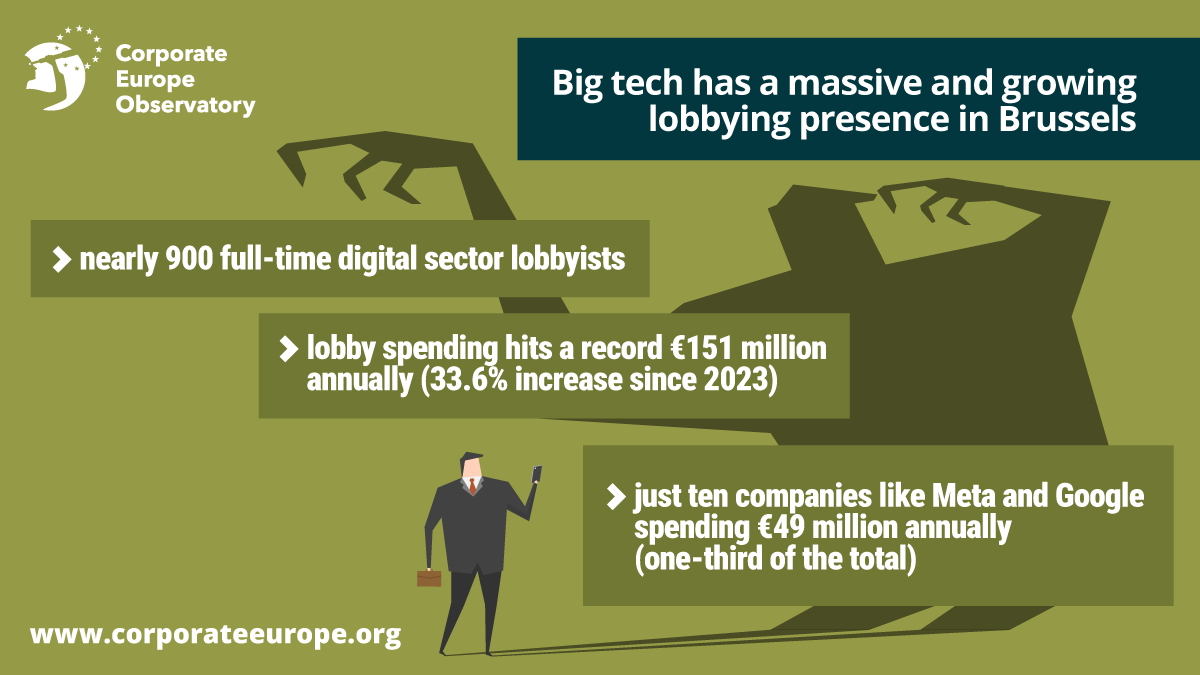
Infographic about big tech lobbying in Brussels, noting nearly 900 lobbyists, €151 million annual spending, and 10 firms spending €49 million, with Corporate Europe Observatory branding.
  • Copy link
  • Flag this comment
  • Block
Corporate Europe Observatory
@corporateeurope@mstdn.social  ·  activity timestamp 2 days ago

🤳 Open phone for one thing. 1h later, you remember it again, after feeling your brain melted by doomscrolling and brainrot.

That’s not a personal failure — it’s by design. The EU wants to curb it. Big Tech is #lobbying hard to keep you hooked.

👀 our new report 👇
https://corporateeurope.org/en/2026/02/addicted-algorithm-how-big-tech-lobbies-keep-us-hooked-social-media

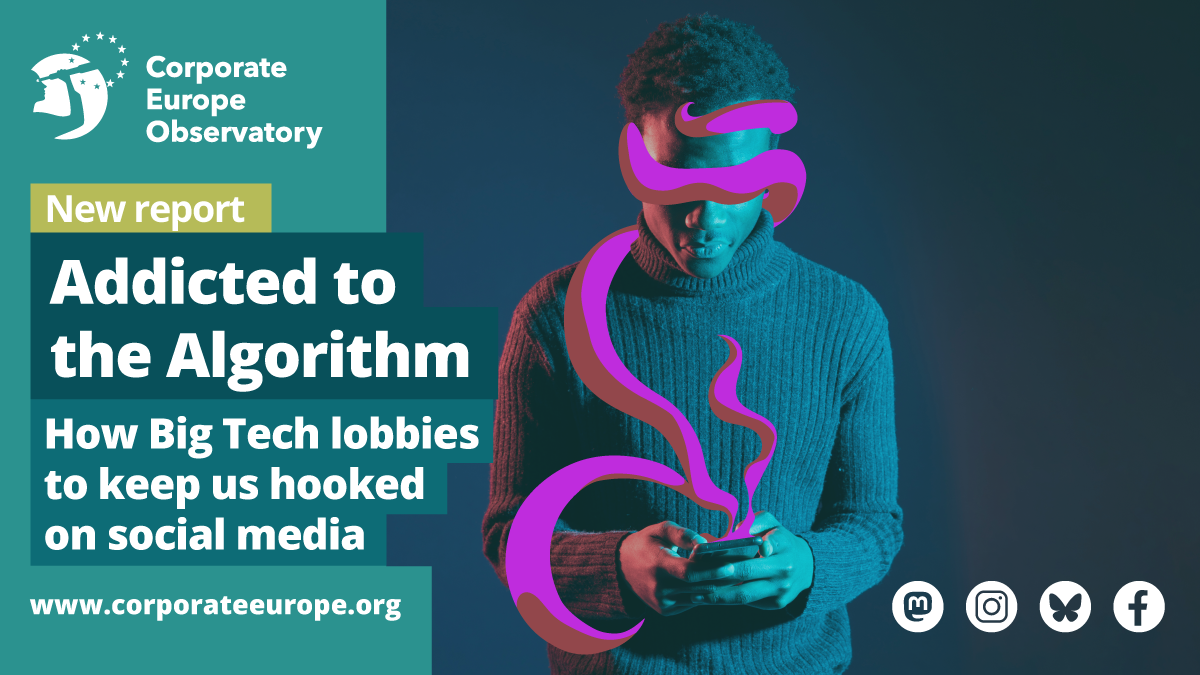
Graphic by Corporate Europe Observatory promoting a report titled ‘Addicted to the algorithm: how Big Tech lobbies to keep us hooked on social media’ A young person looks down at a smartphone, illuminated in blue light, while stylised purple shapes suggest addiction or control. Corporate Europe Observatory logo and website are shown.
Corporate Europe Observatory

Addicted to the algorithm: how Big Tech lobbies to keep us hooked on social media | Corporate Europe Observatory

As the EU prepares the Digital Fairness Act to tackle the addictive nature of social media design, big tech aggressively protects its business models. With Trumpists and far-right allies likely to join the chorus against the DFA, the Commission’s own drive for deregulation at all costs is not helping the chances of strong legislation.
Corporate Europe Observatory
@corporateeurope@mstdn.social replied  ·  activity timestamp 2 days ago

The EU Commission is preparing a Digital Fairness Act with measures against addictive design of social media 👏

Our new investigation reveals intense #lobbying by Big Tech to block such measures 🚨

Will EU decision-makers stand up against Big Tech lobbying?

#DFA

https://www.corporateeurope.org/en/2026/02/addicted-algorithm-how-big-tech-lobbies-keep-us-hooked-social-media

Corporate Europe Observatory

Addicted to the algorithm: how Big Tech lobbies to keep us hooked on social media | Corporate Europe Observatory

As the EU prepares the Digital Fairness Act to tackle the addictive nature of social media design, big tech aggressively protects its business models. With Trumpists and far-right allies likely to join the chorus against the DFA, the Commission’s own drive for deregulation at all costs is not helping the chances of strong legislation.
  • Copy link
  • Flag this comment
  • Block
Corporate Europe Observatory
@corporateeurope@mstdn.social  ·  activity timestamp 2 days ago

🤳 Open phone for one thing. 1h later, you remember it again, after feeling your brain melted by doomscrolling and brainrot.

That’s not a personal failure — it’s by design. The EU wants to curb it. Big Tech is #lobbying hard to keep you hooked.

👀 our new report 👇
https://corporateeurope.org/en/2026/02/addicted-algorithm-how-big-tech-lobbies-keep-us-hooked-social-media

Graphic by Corporate Europe Observatory promoting a report titled ‘Addicted to the algorithm: how Big Tech lobbies to keep us hooked on social media’ A young person looks down at a smartphone, illuminated in blue light, while stylised purple shapes suggest addiction or control. Corporate Europe Observatory logo and website are shown.
Corporate Europe Observatory

Addicted to the algorithm: how Big Tech lobbies to keep us hooked on social media | Corporate Europe Observatory

As the EU prepares the Digital Fairness Act to tackle the addictive nature of social media design, big tech aggressively protects its business models. With Trumpists and far-right allies likely to join the chorus against the DFA, the Commission’s own drive for deregulation at all costs is not helping the chances of strong legislation.
  • Copy link
  • Flag this post
  • Block

BT Free Social

BT Free is a non-profit organization founded by @ozoned@btfree.social . It's goal is for digital privacy rights, advocacy and consulting. This goal will be attained by hosting open platforms to allow others to seamlessly join the Fediverse on moderated instances or by helping others join the Fediverse.

BT Free Social: About · Code of conduct · Privacy ·
Bonfire social · 1.0.1 no JS en
Automatic federation enabled
Log in
  • Explore
  • About
  • Code of Conduct