Big news: this week I joined Commonwealth Fusion Systems, a fusion energy startup developing zero-carbon power to fight climate change. As Head of Content, I’ll be cranking out blogs, social media… | Stephen Shankland | 164 comments
Big news: this week I joined Commonwealth Fusion Systems, a fusion energy startup developing zero-carbon power to fight climate change. As Head of Content, I’ll be cranking out blogs, social media posts, videos, and more. My goal is to help make fusion a mainstream idea as it earns its place in the energy world. The job isn’t journalism, but it’s journalism-adjacent.
I spent 32 years as a science and technology journalist, first covering Los Alamos National Laboratory in my hometown then spending 25 years at CNET chronicling the computing industry. As I ramped up my climate change coverage, I first met CFS in a 2022 look at the fusion startup boom and was impressed.
Fusion won’t be the first enabler of the transition to zero-carbon energy — our house has solar panels and a big battery — but it’ll be big in the long run. Baseload power available 24-7 will be crucial for charging electric vehicles, warming houses in the Northeast in the winter, and powering data centers. One of those chips consumes twice as much power as our entire house. Tech companies are starved for electrical power at the same time they’ve committed to zeroing out their carbon footprint.
Why CFS? The company won me over in several ways, starting with two co-founders I met. Chief Scientific Officer Brandon Sorbom proved to be smart and articulate when I interviewed him for CNET. More recently, over a 2.5-hour dinner meeting, I bombarded CEO Bob Mumgaard with questions about science, technology, funding, roadmaps, competitors, the power grid, personnel, facility siting, China, and more. He had in-depth answers for every question, and his enthusiasm for the CFS mission is infectious.
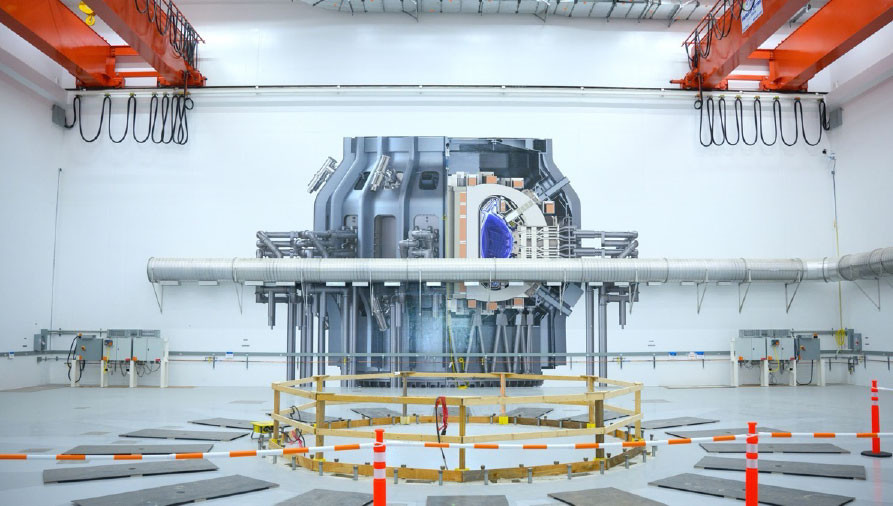
Then there’s the operational rigor. Given fusion’s reputation as a technology that’s perpetually in the future, I was pleased with the CFS hard-nosed approach. CFS focuses on “retiring risk” through experiments, prototypes, and demonstrations. The schedule to deliver the SPARC device — the next major CFS milestone — is deeply detailed and closely monitored. CFS details its work in credible, peer-reviewed research papers to demonstrate its real fusion progress.
The CFS vision is powerfully motivating. There’s a four-phase framework: develop the superconducting magnets (done), build the SPARC machine to prove it works, create the ARC fusion power plants and wire them to the grid, then replace the world’s fossil fuel energy plants. I’ve already seen serious long-term planning and development work.
Last, fusion is just plain cool, at least to me. You can take the kid out of Los Alamos, but you can’t take the Los Alamos out of the kid. Fusion powers the stars, and there are fascinating challenges reproducing it at scale on Earth. Among them: the electromagnets key to CFS’ donut-shaped tokamak devices, their cryogenic cooling system, the “blanket” that captures fusion heat, power plant siting, regulation.
I’m very excited. Get in touch if you have questions!
https://lnkd.in/g-4WEbMX | 164 comments on LinkedIn