Discussion
Loading...

Post

  • About
  • Code of conduct
  • Privacy
  • About Bonfire
John Carlos Baez
@johncarlosbaez@mathstodon.xyz  ·  activity timestamp 2 days ago

Merry Xmas Eve!

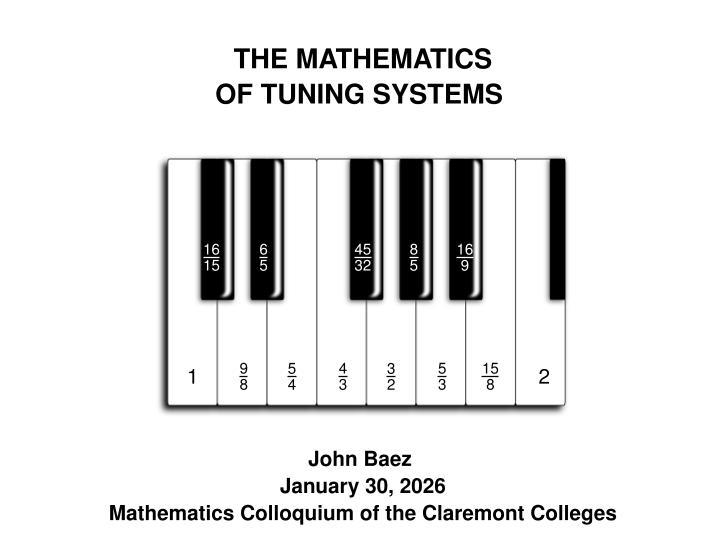
I'm not Christian, I'm Mathematician, but I love Xmas, Ymas and Zmas. I'm giving a talk on the math of tuning systems and I thought I'd share it here as a kind of present to y'all.

I'll start with the basics today and do the more advanced part tomorrow. But I hope even the basics contain a few twists that not everyone knows.

You can read my slides here:

http://math.ucr.edu/home/baez/tuning/tuning_talk.pdf

but they don't contain all the stuff I'm saying here... the stuff I'll say out loud in my talk.

(1/n)
View (PDF)
I won't have the energy to add alt text to all of these, but I'll put the PDF here:

http://math.ucr.edu/home/baez/tuning/tuning_talk.pdf
I won't have the energy to add alt text to all of these, but I'll put the PDF here: http://math.ucr.edu/home/baez/tuning/tuning_talk.pdf
  • Copy link
  • Flag this post
  • Block
John Carlos Baez
@johncarlosbaez@mathstodon.xyz replied  ·  activity timestamp 2 days ago

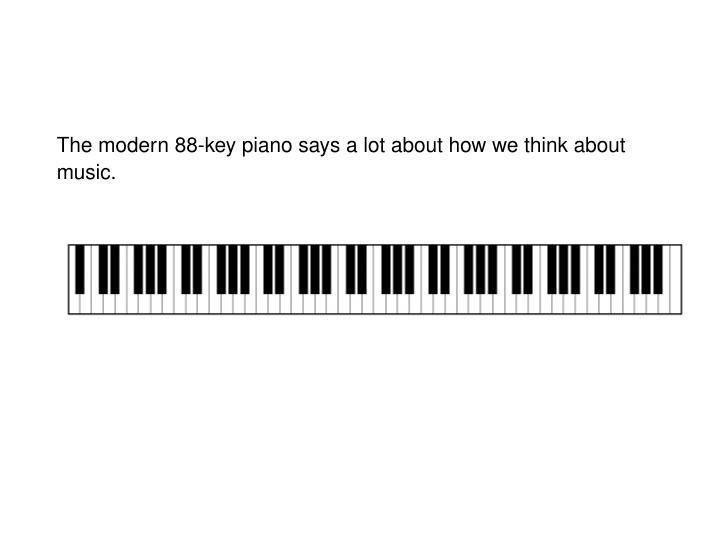
If you look at a piano keyboard you'll see groups of 2 black notes alternating with groups of 3. So the pattern repeats after 5 black notes, but if you count you'll see there are also 7 white notes in this repetitive pattern. So: the pattern repeats each 12 notes.

Some people who never play the piano claim it would be easier if had all white keys, or simply white alternating with black. But in fact the pattern makes it easier to keep track of where you are - and it's not arbitrary, it's musically significant.

(2/n)

Sorry, no caption provided by author
  • Copy link
  • Flag this comment
  • Block
John Carlos Baez
@johncarlosbaez@mathstodon.xyz replied  ·  activity timestamp 2 days ago

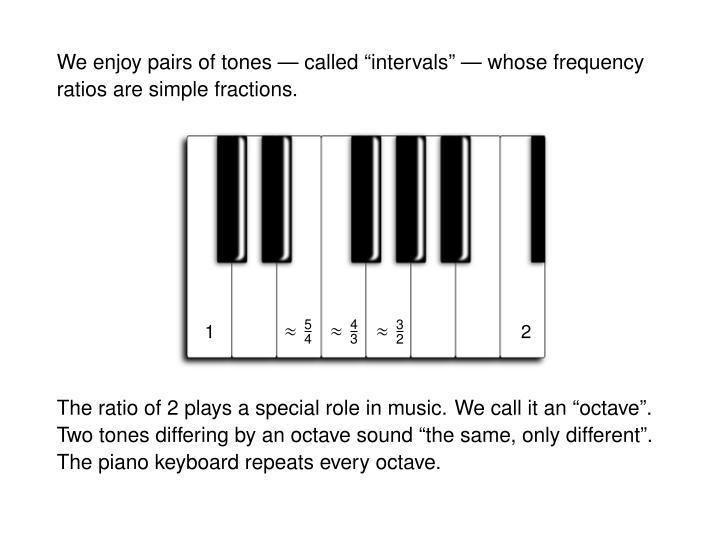
Starting at any note and going up 12 notes, we reach a note whose frequency is almost exactly double the one we started with. Other spacings correspond to other frequency ratios.

I don't want to overwhelm you with numbers. So I'm only showing you a few of the simplest and most important ratios. These are really worth remembering.

(3/ n)

Sorry, no caption provided by author
  • Copy link
  • Flag this comment
  • Block
John Carlos Baez
@johncarlosbaez@mathstodon.xyz replied  ·  activity timestamp 2 days ago

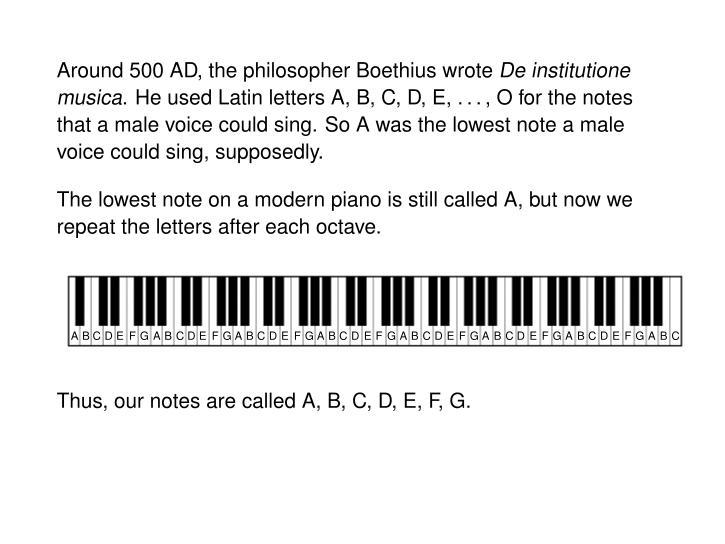
We give the notes letter names. This goes back at least to Boethius, the guy famous for writing The Consolations of Philosophy before he was tortured and killed at the order of Theodoric the Great. (Yeah, "Great".) Boethius was a counselor to Theodoric, but he really would have done better to stay out of politics - he was quite good at math and music theory.

Boethius may be the reason the lowest note on the piano is called A. We now repeat the names of the white notes as shown in the picture: seven white notes A,B,C,D,E,F,G and then it repeats.

[Whoop, Lisa is making me get up, make breakfast and go to the gym. I'll continue this later.]

(4/n)

Sorry, no caption provided by author
  • Copy link
  • Flag this comment
  • Block
John Carlos Baez
@johncarlosbaez@mathstodon.xyz replied  ·  activity timestamp 2 days ago

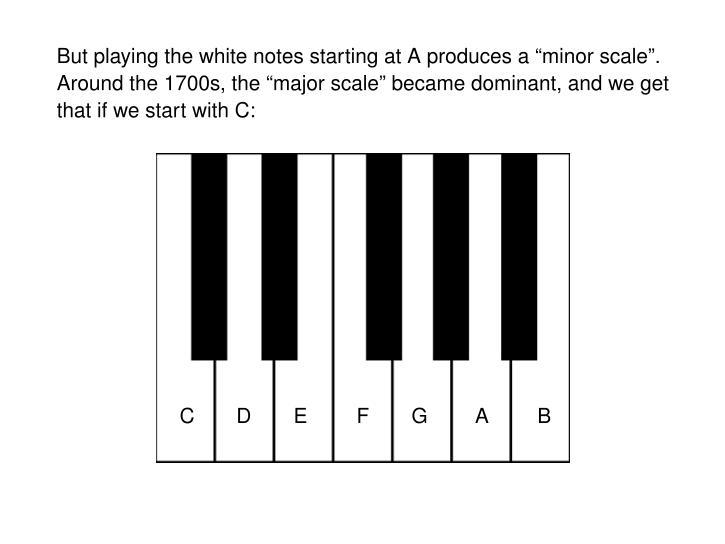
So the scale used to start at A, using only white notes. But due to the irregular spacing of white notes, a scale of all white notes sounds different depending on where you start. Starting at A gives you the "minor scale" or "Aeolian mode", which sounds kinda sad. Now we often start at C, since that gives us the scale most people like best: the "major" scale.

(Good musicians start wherever they want, and get different sounds that way. But "C major" is like the vanilla ice cream of scales - now. It wasn't always this way.)

(5/n)

Sorry, no caption provided by author
  • Copy link
  • Flag this comment
  • Block
John Carlos Baez
@johncarlosbaez@mathstodon.xyz replied  ·  activity timestamp 2 days ago

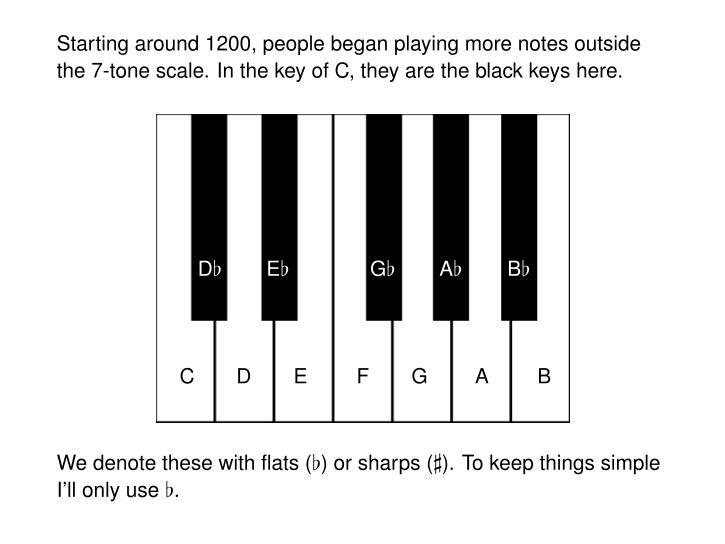
From the late 1100s to about 1600 people called describe pitches that lie outside 7-tone system "musica ficta" ("false" or "fictitious") notes. But gradually these notes - the black keys on the piano if you're playing in C major - became more accepted.

To keep things simple for mathematicians, I'll usually denote these with the "flat" symbol, ♭. For example, G♭ is the black note one down from the white note G.

(Musicians really need both flats and sharps, and they'd also call G♭ something else: F♯. I'll actually need both G♭ and F♯ at some points in this talk!)

(6/n)

Sorry, no caption provided by author
  • Copy link
  • Flag this comment
  • Block
John Carlos Baez
@johncarlosbaez@mathstodon.xyz replied  ·  activity timestamp 2 days ago

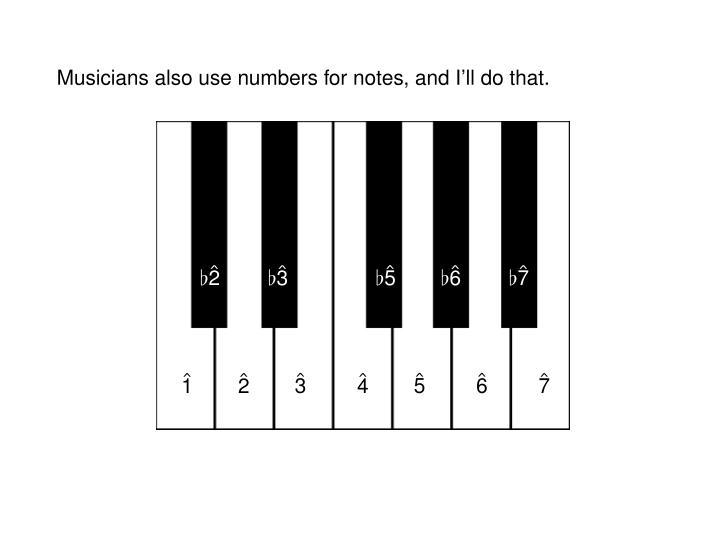
Since starting the scale with the letter C takes a little practice, I'll do it a different way that mathematicians may like better. I'll start with 1 and count up. Musicians put little hats on these numbers, and I'll do that.

For example, we'll call the fifth white note up the scale the "fifth" and write it as a 5 with a little hat.

(7/n)

Sorry, no caption provided by author
  • Copy link
  • Flag this comment
  • Block
Log in

BT Free Social

BT Free is a non-profit organization founded by @ozoned@btfree.social . It's goal is for digital privacy rights, advocacy and consulting. This goal will be attained by hosting open platforms to allow others to seamlessly join the Fediverse on moderated instances or by helping others join the Fediverse.

BT Free Social: About · Code of conduct · Privacy ·
Bonfire community · 1.0.0 no JS en
Automatic federation enabled
  • Explore
  • About
  • Public Groups
  • Code of Conduct
Home
Login