Experts: Trump Plan to Exploit Venezuela’s Oil Would Be “Terrible for the Climate”
This story was originally published by the Guardian and is reproduced here as part of the Climate Desk collaboration.
Donald Trump, by dramatically seizing Nicolás Maduro and claiming dominion over Venezuela’s vast oil reserves, has taken his “drill, baby, drill” mantra global. Achieving the president’s dream of supercharging the country’s oil production would be financially challenging—and if fulfilled, would be “terrible for the climate”, experts say.
Trump has aggressively sought to boost oil and gas production within the US. Now, after the capture and arrest of Maduro and his wife, Cilia Flores, he is seeking to orchestrate a ramp-up of drilling in Venezuela, which has the largest known reserves of oil in the world—equivalent to about 300bn barrels, according to research firm the Energy Institute.
“The oil companies are going to go in, they are going to spend money, we are going to take back the oil, frankly, we should’ve taken back a long time ago,” the US president said after Maduro’s extraction from Caracas. “A lot of money is coming out of the ground, we are going to be reimbursed for everything we spend.”
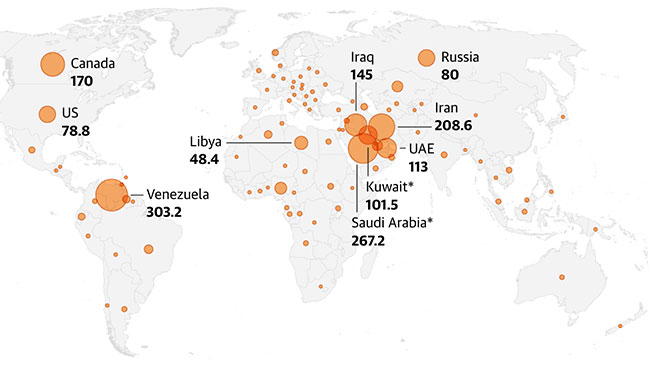 Source: The Oil & Gas Journal. Note: China and Taiwan and Sudan and South Sudan are combined in the data. *Estimates for the Saudi Arabian-Kuwaiti Neutral Zone are divided equally between the two countries.Guardian
US oil companies will “spend billions of dollars, fix the badly broken infrastructure… and start making money for the country,” Trump added, with his administration pressing Venezuela’s interim government to delete a law requiring oil projects to be half-owned by the state.
A 50 percent boost in Venezuelan oil production would result in more carbon pollution than major economies like the UK and Brazil emit.
Leading US oil businesses such as Exxon and Chevron have so far remained silent on whether they would spend the huge sums required to enact the president’s vision for Venezuela. But should Venezuela ramp up output to near its 1970s peak of 3.7 million barrels a day—more than triple current levels—it would further undermine the already faltering global effort to limit dangerous global heating.
Even raising production to 1.5 million barrels of oil a day from current levels of around 1 million barrels would produce around 550 million tons of carbon dioxide a year when the fuel is burned, according to Paasha Mahdavi, an associate professor of political science at the University of California, Santa Barbara. This is more carbon pollution than what is emitted annually by major economies such as the UK and Brazil.
“If there are millions of barrels a day of new oil, that will add quite a lot of carbon dioxide to the atmosphere and the people of Earth can’t afford that,” said John Sterman, an expert in climate and economics at the Massachusetts Institute of Technology.
The climate costs would be especially high because Venezuela produces some of the world’s most carbon-intensive oil. Its vast reserves of extra-heavy crude are particularly dirty, and its other reserves are “also quite carbon- and methane-intensive,” Mahdavi said.
The world is close to breaching agreed temperature increase limits – already suffering more severe heatwaves, storms and droughts as a result. Increased Venezuelan drilling would further lower global oil prices and slow the needed momentum towards renewable energy and electric cars, Sterman added.
“If oil production goes up, climate change will get worse sooner, and everybody loses, including the people of Venezuela,” he said. “The climate damages suffered by Venezuela, along with other countries, will almost certainly outweigh any short-term economic benefit of selling a bit more oil.”
During his first year back in the White House, Trump has demanded the world remain running on fossil fuels rather than “scam” renewables and has threatened the annexation of Canada, a major oil-producing country, and Greenland, an Arctic island rich with mineral resources.
Critics have accused Trump of a fossil fuel-driven “imperialism” that threatens to further destabilize the world’s climate, as well as upend international politics. “The US must stop treating Latin America as a resource colony,” said Elizabeth Bast, the executive director of Oil Change International. “The Venezuelan people, not US oil executives, must shape their country’s future.”
Patrick Galey, head of fossil fuel investigations at the climate and justice NGO Global Witness, said Trump’s aggression in Venezuela is “yet another conflict fuelled by fossil fuels, which are overwhelmingly controlled by some of the world’s most despotic regimes.”
“So long as governments continue to rely on fossil fuels in energy systems, their constituents will be hostage to the whims of autocrats,” he said.
 Oil rigs at Maracaibo Lake in Venezuela’s Zulia state.Leslie Mazoch/AP
Though the president’s stated vision is for US-based oil companies to tap Venezuela’s oil reserves for profit, making good on that promise may be complicated by economic, historical and geological factors, experts say.
Oil companies may not be “eager to invest what’s needed because it will take a lot longer than the three years of President Trump’s term”, said Sterman. “That’s a lot of risk—political risk, project risk,” he said. “It seems very tricky.”
Upping production is “also just a bad bet generally”, said Galey. “Any meaningful increase in current production would require tens of billions of investment in things like repairs, upgrades and replacing creaking infrastructure,” he said. “That’s not even taking into account the dire security situation.”
“The heavy Venezuelan crude that could be refined in US Gulf coast installations is likely going to undercut domestic producers.”
Venezuela’s oil production has fallen dramatically from its historical highs—a decline experts blame on both mismanagement and US sanctions imposed by Barack Obama and escalated by Trump. By 2018, the country was producing just 1.3m barrels a day—roughly half of what it produced when Maduro took office in 2013, just over a third of what it produced in the 1990s, and about a third of its peak production in the 1970s.
Trump has said US companies will revive production levels and be “reimbursed” for the costs of doing so. But the economics of that expansion may not entice energy majors, and even if they choose to play along, it would take years to meaningful boost extraction, experts say.
Boosting Venezuela’s oil output by 500,000 barrels a day would cost about $10bn and take roughly two years, according to Energy Aspects. Production could reach between 2 million and 2.5 million barrels a day within a decade by tapping medium crude reserves, Mahdavi said. But returning to peak output would require developing the Orinoco Belt, whose heavy, sulfur-rich crude is far more costly and difficult to extract, transport and refine.
Returning to 2 million barrels per day by the early 2030s would require about $110 billion in investment, according to Rystad Energy, an industry consultancy.
“That is going to take much more time and much more money, to be able to get at or close to maybe 3, 4 or 5 million barrels a day of production,” said Mahdavi.
Increasing Venezuelan extraction amid booming US production may also be a hard sell. “The heavy Venezuelan crude that could be refined in US Gulf coast installations is likely going to undercut domestic producers, who until Trump kidnapped Maduro had been vocally supportive of sanctions on Venezuelan oil,” said Galey.
Some firms may be willing to “eat that uncertainty” because the US plans to provide companies with financial support to drill in Venezuela, said Mahdavi.
“If you’re willing to deal with the challenges…you are looking still at relatively cheap crude that will get you a higher profit margin than what you can do in the United States,” he said. “That’s why they’re still interested: It’s way more expensive to drill in, say, the US’s Permian Basin.”
Some US oil majors may be more receptive to Trump’s Venezuela strategy. Chevron, the only US company operating in the country, may be poised scale up production faster than its rivals. And ExxonMobil, which has invested heavily in oil production within neighboring Guyana, could benefit from the removal of Maduro, who staunchly opposes that expansion.
Overall, however, it remains unclear how US oil majors will respond to Trump’s plans of regime change and increased oil extraction in Venezuela. What is much clearer is that any expansion would be “terrible for the climate, terrible for the environment,” said Mahdavi.
This post has been syndicated from Mother Jones, where it was published under this address.