A page from The People's History of the United States, Chapter 12, The Empire and the People

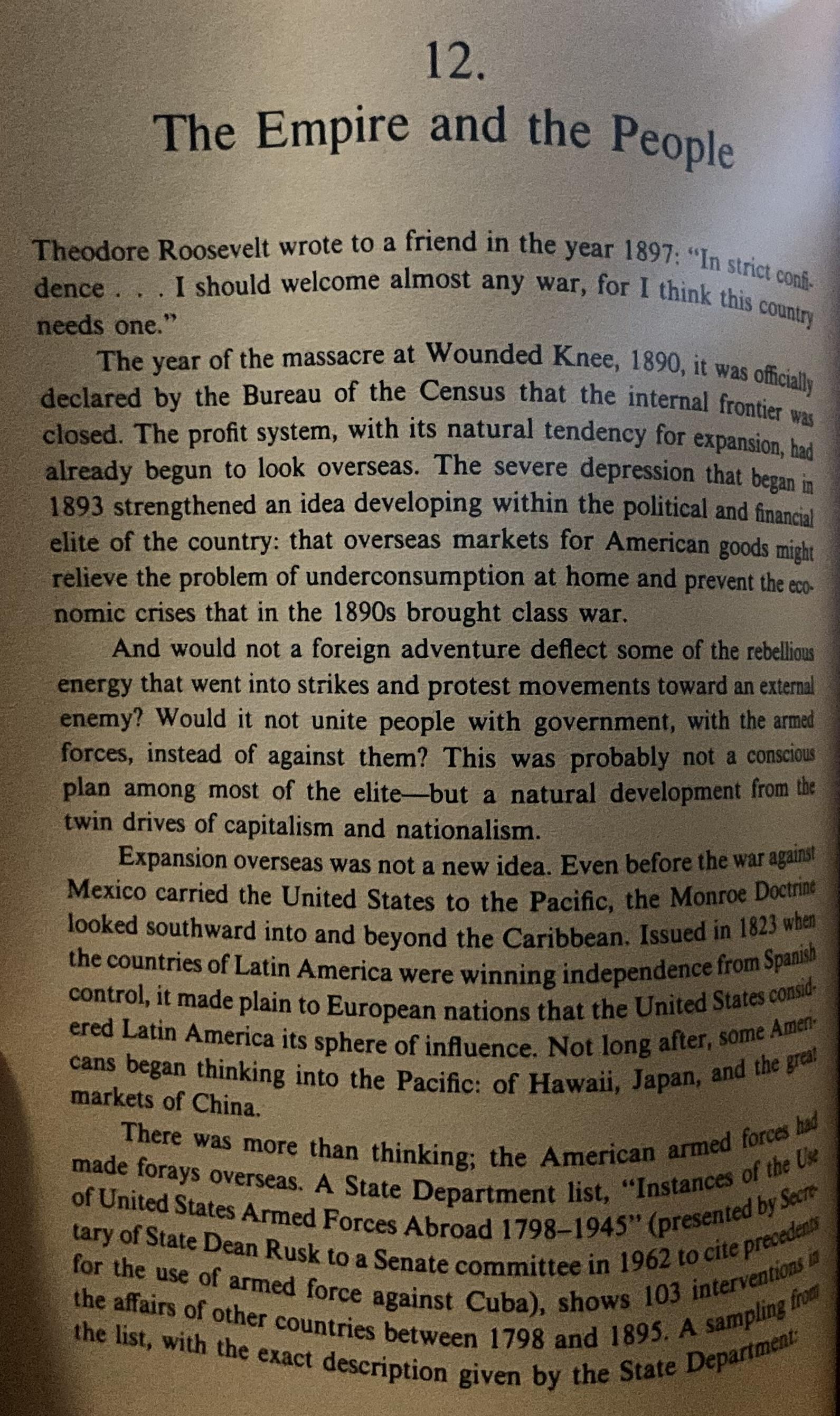
Theodore Roosevelt wrote to a friend in the year 1897: "In strict confidence, I should welcome almost any war, for I think this country needs one."
The year of the massacre at Wounded Knee, 1890, it was officially declared by the Bureau of the Census that the internal frontier was closed. The profit system, with its natural tendency for expansion, had already begun to look overseas. The severe depression that began in 1893 strengthened an idea developing within the political and financial elite of the country: that overseas markets for American goods might relieve the problem of underconsumption at home and prevent the economic crises that in the 1890s brought class war.
And would not a foreign adventure deflect some of the rebellious energy that went into strikes and protest movements toward an external enemy? Would it not unite people with government, with the armed forces, instead of against them? This was probably not a conscious plan among most of the elite-but a natural development from the twin drives of capitalism and nationalism.
Expansion overseas was not a new idea. Even before the war agans.
Mexico carried the United States to the Pacific, the Monroe Doctrne looked southward into and beyond the Caribbean. Issued in 1823 when the countries of Latin America were winning independence from Spanish control, it made plain to European nations that the United States considered...
A page from The People's History of the United States, Chapter 12, The Empire and the People Theodore Roosevelt wrote to a friend in the year 1897: "In strict confidence, I should welcome almost any war, for I think this country needs one." The year of the massacre at Wounded Knee, 1890, it was officially declared by the Bureau of the Census that the internal frontier was closed. The profit system, with its natural tendency for expansion, had already begun to look overseas. The severe depression that began in 1893 strengthened an idea developing within the political and financial elite of the country: that overseas markets for American goods might relieve the problem of underconsumption at home and prevent the economic crises that in the 1890s brought class war. And would not a foreign adventure deflect some of the rebellious energy that went into strikes and protest movements toward an external enemy? Would it not unite people with government, with the armed forces, instead of against them? This was probably not a conscious plan among most of the elite-but a natural development from the twin drives of capitalism and nationalism. Expansion overseas was not a new idea. Even before the war agans. Mexico carried the United States to the Pacific, the Monroe Doctrne looked southward into and beyond the Caribbean. Issued in 1823 when the countries of Latin America were winning independence from Spanish control, it made plain to European nations that the United States considered...
A page from The People's History of the United States, Chapter 12, The Empire and the People

Theodore Roosevelt wrote to a friend in the year 1897: "In strict confidence, I should welcome almost any war, for I think this country needs one."
The year of the massacre at Wounded Knee, 1890, it was officially declared by the Bureau of the Census that the internal frontier was closed. The profit system, with its natural tendency for expansion, had already begun to look overseas. The severe depression that began in 1893 strengthened an idea developing within the political and financial elite of the country: that overseas markets for American goods might relieve the problem of underconsumption at home and prevent the economic crises that in the 1890s brought class war.
And would not a foreign adventure deflect some of the rebellious energy that went into strikes and protest movements toward an external enemy? Would it not unite people with government, with the armed forces, instead of against them? This was probably not a conscious plan among most of the elite-but a natural development from the twin drives of capitalism and nationalism.
Expansion overseas was not a new idea. Even before the war agans.
Mexico carried the United States to the Pacific, the Monroe Doctrne looked southward into and beyond the Caribbean. Issued in 1823 when the countries of Latin America were winning independence from Spanish control, it made plain to European nations that the United States considered...
A page from The People's History of the United States, Chapter 12, The Empire and the People Theodore Roosevelt wrote to a friend in the year 1897: "In strict confidence, I should welcome almost any war, for I think this country needs one." The year of the massacre at Wounded Knee, 1890, it was officially declared by the Bureau of the Census that the internal frontier was closed. The profit system, with its natural tendency for expansion, had already begun to look overseas. The severe depression that began in 1893 strengthened an idea developing within the political and financial elite of the country: that overseas markets for American goods might relieve the problem of underconsumption at home and prevent the economic crises that in the 1890s brought class war. And would not a foreign adventure deflect some of the rebellious energy that went into strikes and protest movements toward an external enemy? Would it not unite people with government, with the armed forces, instead of against them? This was probably not a conscious plan among most of the elite-but a natural development from the twin drives of capitalism and nationalism. Expansion overseas was not a new idea. Even before the war agans. Mexico carried the United States to the Pacific, the Monroe Doctrne looked southward into and beyond the Caribbean. Issued in 1823 when the countries of Latin America were winning independence from Spanish control, it made plain to European nations that the United States considered...
AstroMancer5G (she/her) and 2 others boosted
Roknrol boosted