2020 April 7

A Path North
Image Credit & Copyright: Mario Konang

Explanation: 
What happens if you keep going north? The direction north on the Earth, the place on your horizon below the northern spin pole of the Earth -- around which other stars appear to slowly swirl, will remain the same. This spin-pole-of-the-north will never move from its fixed location on the sky -- night or day -- and its height will always match your latitude. The further north you go, the higher the north spin pole will appear. Eventually, if you can reach the Earth's North Pole, the stars will circle a point directly over your head. Pictured, a four-hour long stack of images shows stars trailing in circles around this north celestial pole. The bright star near the north celestial pole is Polaris, known as the North Star. The bright path was created by the astrophotographer's headlamp as he zigzagged up a hill just over a week ago in Lower Saxony, Germany. The astrophotographer can be seen, at times, in shadow. Actually, the Earth has two spin poles -- and much the same would happen if you started below the Earth's equator and went south. 

Authors & editors: Robert Nemiroff (MTU) & Jerry Bonnell (UMCP)
NASA Official: Phillip Newman Specific rights apply.
NASA Web Privacy Policy and Important Notices
A service of: ASD at NASA / GSFC
& Michigan Tech. U.
2020 April 7 A Path North Image Credit & Copyright: Mario Konang Explanation: What happens if you keep going north? The direction north on the Earth, the place on your horizon below the northern spin pole of the Earth -- around which other stars appear to slowly swirl, will remain the same. This spin-pole-of-the-north will never move from its fixed location on the sky -- night or day -- and its height will always match your latitude. The further north you go, the higher the north spin pole will appear. Eventually, if you can reach the Earth's North Pole, the stars will circle a point directly over your head. Pictured, a four-hour long stack of images shows stars trailing in circles around this north celestial pole. The bright star near the north celestial pole is Polaris, known as the North Star. The bright path was created by the astrophotographer's headlamp as he zigzagged up a hill just over a week ago in Lower Saxony, Germany. The astrophotographer can be seen, at times, in shadow. Actually, the Earth has two spin poles -- and much the same would happen if you started below the Earth's equator and went south. Authors & editors: Robert Nemiroff (MTU) & Jerry Bonnell (UMCP) NASA Official: Phillip Newman Specific rights apply. NASA Web Privacy Policy and Important Notices A service of: ASD at NASA / GSFC & Michigan Tech. U.
TOPIC> "Stars On A Trail" https://defcon.social/@grobi/114538103004457677 This thread about Star Trails is a long trip through the photo archives of NASA and ESA. Some of you have already seen my affinity for these archives, and in threads like this one I would like to make you understand my fascination. So if you like, follow me this time on my trail in all directions back and forward in time, past beautiful, special, extreme and even magical places, through a gallery of wonderful images, provided by great often volunteer astrophotographers who are generous enough to share their love and fascination for the stars around us .. Please visit their websites, leave friendly and encouraging comments and maybe you will even have the opportunity to support them financially or logistically. On each of my posts you can find a link to the archive pages and many of the astrophotographers leave a link there or even a mail-address I can hardly express my great gratitude for all the magic and beauty and I sincerely hope that these archives will be available to us for a long time to come! But you never know, with the power-obsessed destructive Lunatics these days.. Anyway, I really hope you enjoy this trail with me. >> https://defcon.social/@grobi/114538103004457677 * Music: The Church - Under The Milky Way ** Video Credit: Beatriz @Beatriz_ https://www.youtube.com/@Beatriz_ *** Thumbnail Credit: Mario Konang from Lower Saxonie Germany <3
 
2020 February 12

Star Trails of the North and South
 * Image Credit & Copyright: Saeid Parchini

Explanation: 
What divides the north from the south? It all has to do with the spin of the Earth. On Earth's surface, the equator is the dividing line, but on Earth's sky, the dividing line is the Celestial Equator -- the equator's projection onto the sky.  You likely can't see the Earth's equator around you, but anyone with a clear night sky can find the Celestial Equator by watching stars move.  Just locate the dividing line between stars that arc north and stars that arc south. Were you on Earth's equator, the Celestial Equator would go straight up and down.  In general, the angle between the Celestial Equator and the vertical is your latitude.  The featured image combines 325 photos taken every 30 seconds over 162 minutes. Taken soon after sunset earlier this month, moonlight illuminates a snowy and desolate scene in northwest Iran. The bright streak behind the lone tree is the planet Venus setting. 

Authors & editors: Robert Nemiroff (MTU) & Jerry Bonnell (UMCP)
NASA Official: Phillip Newman Specific rights apply.
NASA Web Privacy Policy and Important Notices
A service of: ASD at NASA / GSFC
& Michigan Tech. U.
2020 February 12 Star Trails of the North and South * Image Credit & Copyright: Saeid Parchini Explanation: What divides the north from the south? It all has to do with the spin of the Earth. On Earth's surface, the equator is the dividing line, but on Earth's sky, the dividing line is the Celestial Equator -- the equator's projection onto the sky. You likely can't see the Earth's equator around you, but anyone with a clear night sky can find the Celestial Equator by watching stars move. Just locate the dividing line between stars that arc north and stars that arc south. Were you on Earth's equator, the Celestial Equator would go straight up and down. In general, the angle between the Celestial Equator and the vertical is your latitude. The featured image combines 325 photos taken every 30 seconds over 162 minutes. Taken soon after sunset earlier this month, moonlight illuminates a snowy and desolate scene in northwest Iran. The bright streak behind the lone tree is the planet Venus setting. Authors & editors: Robert Nemiroff (MTU) & Jerry Bonnell (UMCP) NASA Official: Phillip Newman Specific rights apply. NASA Web Privacy Policy and Important Notices A service of: ASD at NASA / GSFC & Michigan Tech. U.
2024 August 17

Sky Full of Arcs
 * Image Credit & Copyright: Rory Gannaway

Explanation: 
On August 11 a Rocket Lab Electron rocket launched from a rotating planet. With a small satellite on board its mission was dubbed A Sky Full of SARs (Synthetic Aperture Radar satellites), departing for low Earth orbit from Mahia Peninsula on New Zealand's north island. The fiery trace of the Electron's graceful launch arc is toward the east in this southern sea and skyscape, a composite of 50 consecutive frames taken over 2.5 hours. Fixed to a tripod, the camera was pointing directly at the South Celestial Pole, the extension of planet Earth's axis of rotation in to space. But no bright star marks that location in the southern hemisphere's night sky. Still, the South Celestial Pole is easy to spot. It lies at the center of the concentric star trail arcs that fill the skyward field of view. 

Authors & editors: Robert Nemiroff (MTU) & Jerry Bonnell (UMCP)
NASA Official: Amber Straughn Specific rights apply.
NASA Web Privacy, Accessibility Notices
A service of: ASD at NASA / GSFC,
NASA Science Activation
& Michigan Tech. U.
2024 August 17 Sky Full of Arcs * Image Credit & Copyright: Rory Gannaway Explanation: On August 11 a Rocket Lab Electron rocket launched from a rotating planet. With a small satellite on board its mission was dubbed A Sky Full of SARs (Synthetic Aperture Radar satellites), departing for low Earth orbit from Mahia Peninsula on New Zealand's north island. The fiery trace of the Electron's graceful launch arc is toward the east in this southern sea and skyscape, a composite of 50 consecutive frames taken over 2.5 hours. Fixed to a tripod, the camera was pointing directly at the South Celestial Pole, the extension of planet Earth's axis of rotation in to space. But no bright star marks that location in the southern hemisphere's night sky. Still, the South Celestial Pole is easy to spot. It lies at the center of the concentric star trail arcs that fill the skyward field of view. Authors & editors: Robert Nemiroff (MTU) & Jerry Bonnell (UMCP) NASA Official: Amber Straughn Specific rights apply. NASA Web Privacy, Accessibility Notices A service of: ASD at NASA / GSFC, NASA Science Activation & Michigan Tech. U.
2024 May 18

North Celestial Aurora
 * Image Credit & Copyright: Chirag Upreti

Explanation: 
Graceful star trail arcs reflect planet Earth's daily rotation in this colorful night skyscape. To create the timelapse composite, on May 12 consecutive exposures were recorded with a camera fixed to a tripod on the shores of the Ashokan Reservoir, in the Catskills region of New York, USA. North star Polaris is near the center of the star trail arcs. The broad trail of a waxing crescent Moon is on the left, casting a strong reflection across the reservoir waters. With intense solar activity driving recent geomagnetic storms, the colorful aurora borealis or northern lights, rare to the region, shine under Polaris and the north celestial pole. 

Authors & editors: Robert Nemiroff (MTU) & Jerry Bonnell (UMCP)
NASA Official: Amber Straughn Specific rights apply.
NASA Web Privacy, Accessibility Notices
A service of: ASD at NASA / GSFC,
NASA Science Activation
& Michigan Tech. U.
2024 May 18 North Celestial Aurora * Image Credit & Copyright: Chirag Upreti Explanation: Graceful star trail arcs reflect planet Earth's daily rotation in this colorful night skyscape. To create the timelapse composite, on May 12 consecutive exposures were recorded with a camera fixed to a tripod on the shores of the Ashokan Reservoir, in the Catskills region of New York, USA. North star Polaris is near the center of the star trail arcs. The broad trail of a waxing crescent Moon is on the left, casting a strong reflection across the reservoir waters. With intense solar activity driving recent geomagnetic storms, the colorful aurora borealis or northern lights, rare to the region, shine under Polaris and the north celestial pole. Authors & editors: Robert Nemiroff (MTU) & Jerry Bonnell (UMCP) NASA Official: Amber Straughn Specific rights apply. NASA Web Privacy, Accessibility Notices A service of: ASD at NASA / GSFC, NASA Science Activation & Michigan Tech. U.
2020 April 17

The Windmill and the Star Trails
 * Image Credit & Copyright: Antonio Gonzalez

Explanation: 
Stars can't turn these old wooden arms, but it does look like they might in this scene from a rotating planet. The well-composed night skyscape was recorded from Garafia, a municipality on the island of La Palma, Canary Islands, planet Earth. The center of the once working windmill, retired since 1953, is lined-up with the north celestial pole, the planet's rotation axis projected on to the northern sky. From a camera fixed to a tripod, the star trails are a reflection of the planet's rotation traced in a digital composite of 39 sequential exposures each 25 seconds long. Brought out by highlighting the final exposure in the sequence, the stars themselves appear at the ends of their short concentric arcs. A faint band of winter's Milky Way and even a diffuse glow from our neighboring Andromeda Galaxy also shine in the night. 

Authors & editors: Robert Nemiroff (MTU) & Jerry Bonnell (UMCP)
NASA Official: Phillip Newman Specific rights apply.
NASA Web Privacy Policy and Important Notices
A service of: ASD at NASA / GSFC
& Michigan Tech. U.
2020 April 17 The Windmill and the Star Trails * Image Credit & Copyright: Antonio Gonzalez Explanation: Stars can't turn these old wooden arms, but it does look like they might in this scene from a rotating planet. The well-composed night skyscape was recorded from Garafia, a municipality on the island of La Palma, Canary Islands, planet Earth. The center of the once working windmill, retired since 1953, is lined-up with the north celestial pole, the planet's rotation axis projected on to the northern sky. From a camera fixed to a tripod, the star trails are a reflection of the planet's rotation traced in a digital composite of 39 sequential exposures each 25 seconds long. Brought out by highlighting the final exposure in the sequence, the stars themselves appear at the ends of their short concentric arcs. A faint band of winter's Milky Way and even a diffuse glow from our neighboring Andromeda Galaxy also shine in the night. Authors & editors: Robert Nemiroff (MTU) & Jerry Bonnell (UMCP) NASA Official: Phillip Newman Specific rights apply. NASA Web Privacy Policy and Important Notices A service of: ASD at NASA / GSFC & Michigan Tech. U.
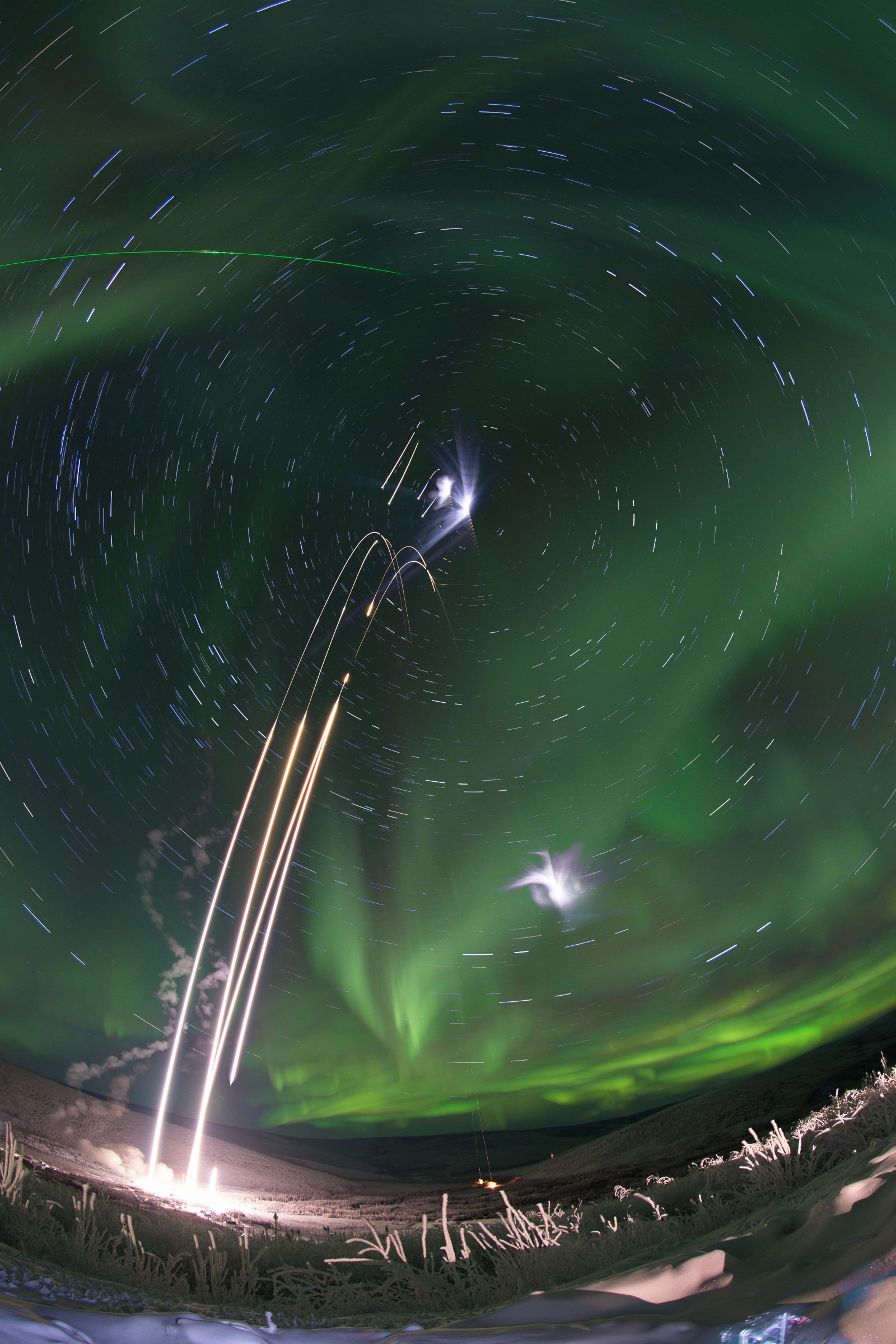
2015 January 30

A Night at Poker Flat
 * Image Credit: NASA / Jamie Adkins

Explanation: 
Four NASA suborbital sounding rockets leapt into the night on January 26, from the University of Alaska's Poker Flat Research Range. This time lapse composite image follows all four launches of the small, multi-stage rockets to explore winter's mesmerizing, aurora-filled skies. During the exposures, stars trailed around the North Celestial Pole, high above the horizon at the site 30 miles north of Fairbanks, Alaska. Lidar, beams of pulsed green lasers, also left traces through the scene. Operating successfully, the payloads lofted were two Mesosphere-Lower Thermosphere Turbulence Experiments (M-TeX) and two Mesospheric Inversion-layer Stratified Turbulence (MIST) experiments, creating vapor trails at high altitudes to be tracked by ground-based observations. 

Authors & editors: Robert Nemiroff (MTU) & Jerry Bonnell (UMCP)
NASA Official: Phillip Newman Specific rights apply.
NASA Web Privacy Policy and Important Notices
A service of: ASD at NASA / GSFC
& Michigan Tech. U.
2015 January 30 A Night at Poker Flat * Image Credit: NASA / Jamie Adkins Explanation: Four NASA suborbital sounding rockets leapt into the night on January 26, from the University of Alaska's Poker Flat Research Range. This time lapse composite image follows all four launches of the small, multi-stage rockets to explore winter's mesmerizing, aurora-filled skies. During the exposures, stars trailed around the North Celestial Pole, high above the horizon at the site 30 miles north of Fairbanks, Alaska. Lidar, beams of pulsed green lasers, also left traces through the scene. Operating successfully, the payloads lofted were two Mesosphere-Lower Thermosphere Turbulence Experiments (M-TeX) and two Mesospheric Inversion-layer Stratified Turbulence (MIST) experiments, creating vapor trails at high altitudes to be tracked by ground-based observations. Authors & editors: Robert Nemiroff (MTU) & Jerry Bonnell (UMCP) NASA Official: Phillip Newman Specific rights apply. NASA Web Privacy Policy and Important Notices A service of: ASD at NASA / GSFC & Michigan Tech. U.