Discussion
Loading...

#Tag

Log in
  • About
  • Code of conduct
  • Privacy
  • About Bonfire
Nelfaneor 🇪🇺 🇧🇪 🫏​✒️​♏​〽️​🟤​ boosted
Open Book Publishers
@OpenBookPublish@hcommons.social  ·  activity timestamp 24 hours ago

NEW TITLE | Neomania: How Our Obsession With Innovation is Failing Science, and How to Restore Trust by Krist Vaesen

Vaesen argues that worshipping the “new” has fractured science and eroded trust, and presents a sharp, constructive case for rebuilding research around reliability, and truth.

Read for free or buy a copy: https://doi.org/10.11647/OBP.0507

#OAbooks #OpenScience

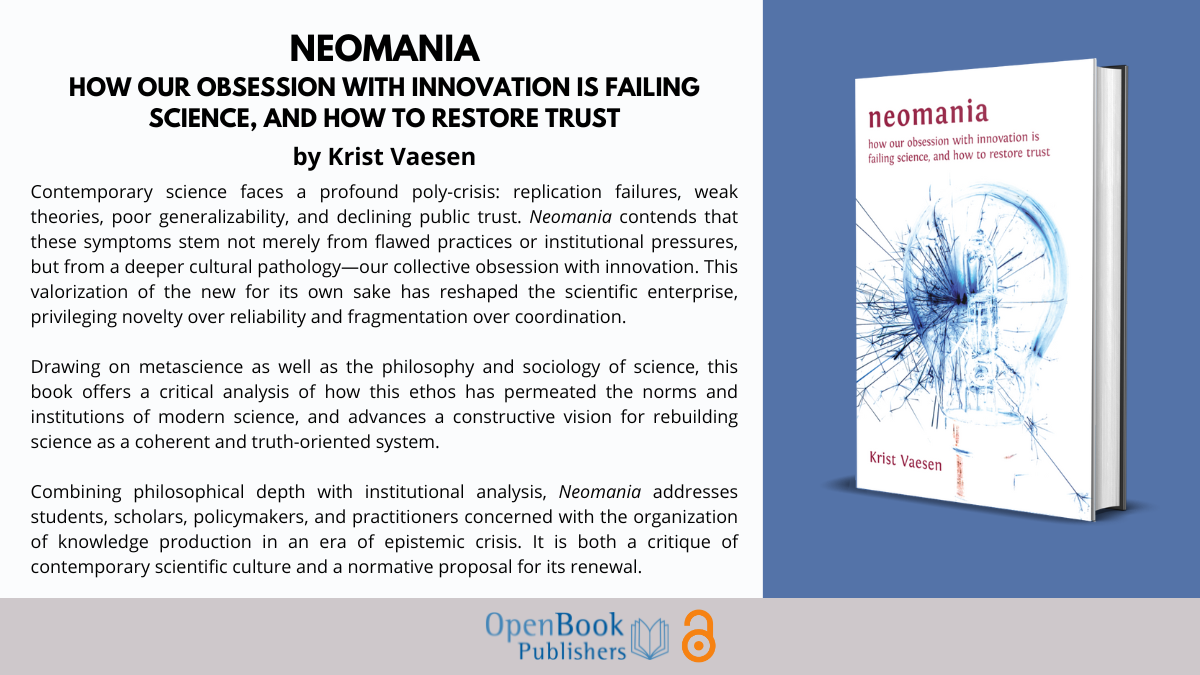
The book jacket on a colourful background alongside text that says:

Neomania: How Our Obsession With Innovation is Failing Science, and How to Restore Trust by Krist Vaesen

Contemporary science faces a profound poly-crisis: replication failures, weak theories, poor generalizability, and declining public trust. Neomania contends that these symptoms stem not merely from flawed practices or institutional pressures, but from a deeper cultural pathology—our collective obsession with innovation. This valorization of the new for its own sake has reshaped the scientific enterprise, privileging novelty over reliability and fragmentation over coordination.

Drawing on metascience as well as the philosophy and sociology of science, this book offers a critical analysis of how this ethos has permeated the norms and institutions of modern science, and advances a constructive vision for rebuilding science as a coherent and truth-oriented system. 

Combining philosophical depth with institutional analysis, Neomania addresses students, scholars, policymakers, and practitioners concerned with the organization of knowledge production in an era of epistemic crisis. It is both a critique of contemporary scientific culture and a normative proposal for its renewal.
The book jacket on a colourful background alongside text that says: Neomania: How Our Obsession With Innovation is Failing Science, and How to Restore Trust by Krist Vaesen Contemporary science faces a profound poly-crisis: replication failures, weak theories, poor generalizability, and declining public trust. Neomania contends that these symptoms stem not merely from flawed practices or institutional pressures, but from a deeper cultural pathology—our collective obsession with innovation. This valorization of the new for its own sake has reshaped the scientific enterprise, privileging novelty over reliability and fragmentation over coordination. Drawing on metascience as well as the philosophy and sociology of science, this book offers a critical analysis of how this ethos has permeated the norms and institutions of modern science, and advances a constructive vision for rebuilding science as a coherent and truth-oriented system. Combining philosophical depth with institutional analysis, Neomania addresses students, scholars, policymakers, and practitioners concerned with the organization of knowledge production in an era of epistemic crisis. It is both a critique of contemporary scientific culture and a normative proposal for its renewal.
  • Copy link
  • Flag this post
  • Block
Open Book Publishers
@OpenBookPublish@hcommons.social  ·  activity timestamp 24 hours ago

NEW TITLE | Neomania: How Our Obsession With Innovation is Failing Science, and How to Restore Trust by Krist Vaesen

Vaesen argues that worshipping the “new” has fractured science and eroded trust, and presents a sharp, constructive case for rebuilding research around reliability, and truth.

Read for free or buy a copy: https://doi.org/10.11647/OBP.0507

#OAbooks #OpenScience

The book jacket on a colourful background alongside text that says:

Neomania: How Our Obsession With Innovation is Failing Science, and How to Restore Trust by Krist Vaesen

Contemporary science faces a profound poly-crisis: replication failures, weak theories, poor generalizability, and declining public trust. Neomania contends that these symptoms stem not merely from flawed practices or institutional pressures, but from a deeper cultural pathology—our collective obsession with innovation. This valorization of the new for its own sake has reshaped the scientific enterprise, privileging novelty over reliability and fragmentation over coordination.

Drawing on metascience as well as the philosophy and sociology of science, this book offers a critical analysis of how this ethos has permeated the norms and institutions of modern science, and advances a constructive vision for rebuilding science as a coherent and truth-oriented system. 

Combining philosophical depth with institutional analysis, Neomania addresses students, scholars, policymakers, and practitioners concerned with the organization of knowledge production in an era of epistemic crisis. It is both a critique of contemporary scientific culture and a normative proposal for its renewal.
The book jacket on a colourful background alongside text that says: Neomania: How Our Obsession With Innovation is Failing Science, and How to Restore Trust by Krist Vaesen Contemporary science faces a profound poly-crisis: replication failures, weak theories, poor generalizability, and declining public trust. Neomania contends that these symptoms stem not merely from flawed practices or institutional pressures, but from a deeper cultural pathology—our collective obsession with innovation. This valorization of the new for its own sake has reshaped the scientific enterprise, privileging novelty over reliability and fragmentation over coordination. Drawing on metascience as well as the philosophy and sociology of science, this book offers a critical analysis of how this ethos has permeated the norms and institutions of modern science, and advances a constructive vision for rebuilding science as a coherent and truth-oriented system. Combining philosophical depth with institutional analysis, Neomania addresses students, scholars, policymakers, and practitioners concerned with the organization of knowledge production in an era of epistemic crisis. It is both a critique of contemporary scientific culture and a normative proposal for its renewal.
  • Copy link
  • Flag this post
  • Block
Nelfaneor 🇪🇺 🇧🇪 🫏​✒️​♏​〽️​🟤​ boosted
Open Book Publishers
@OpenBookPublish@hcommons.social  ·  activity timestamp 3 days ago

NEW BOOK: Our first title in February is an addition to the Cambridge Semitic Languages and Cultures series, al-Dānī's al-Taysīr fī al-qirāʾāt al-sabʿ: A Translation with Linguistic Commentary by Marijn van Putten!

Read freely online or buy a copy: https://www.openbookpublishers.com/books/10.11647/obp.0475

#OAbooks #SemiticSeries #OpenAccess

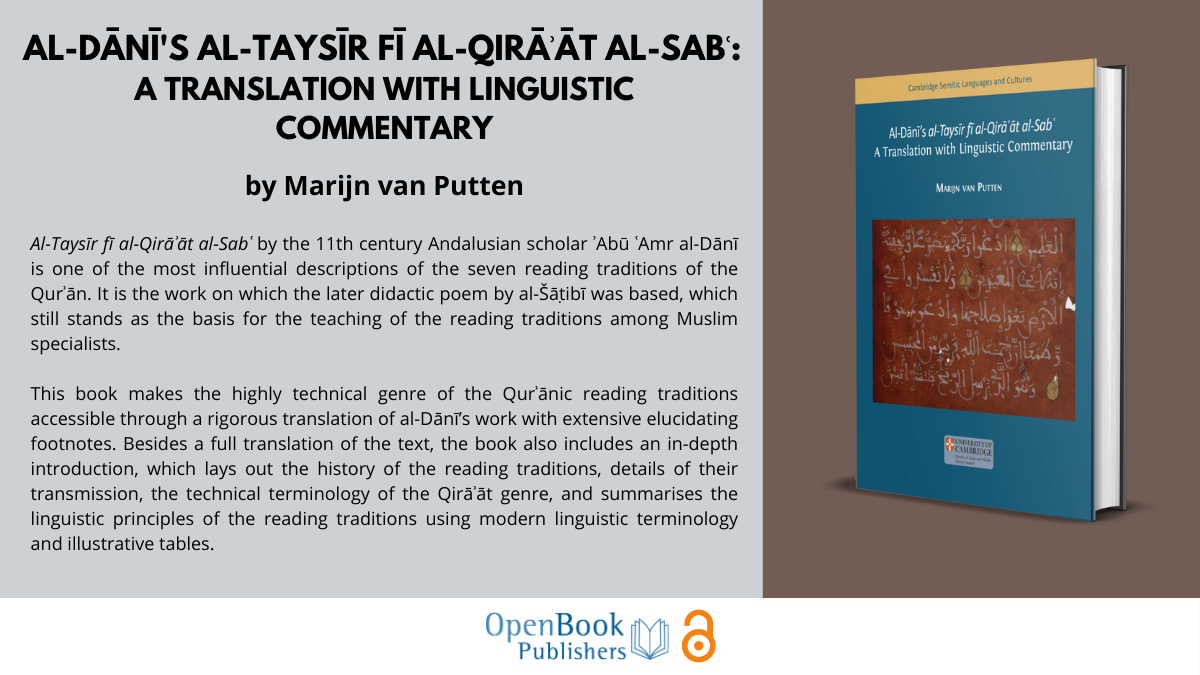
An image of the book against a colourful background next to text that says:

al-Dānī's al-Taysīr fī al-qirāʾāt al-sabʿ: 
A Translation with Linguistic Commentary by Marijn van Putten

Al-Taysīr fī al-Qirāʾāt al-Sabʿ by the 11th century Andalusian scholar ʾAbū ʿAmr al-Dānī is one of the most influential descriptions of the seven reading traditions of the Qurʾān. It is the work on which the later didactic poem by al-Šāṭibī was based, which still stands as the basis for the teaching of the reading traditions among Muslim specialists. 

This book makes the highly technical genre of the Qurʾānic reading traditions accessible through a rigorous translation of al-Dānī’s work with extensive elucidating footnotes. Besides a full translation of the text, the book also includes an in-depth introduction, which lays out the history of the reading traditions, details of their transmission, the technical terminology of the Qirāʾāt genre, and summarises the linguistic principles of the reading traditions using modern linguistic terminology and illustrative tables.
An image of the book against a colourful background next to text that says: al-Dānī's al-Taysīr fī al-qirāʾāt al-sabʿ: A Translation with Linguistic Commentary by Marijn van Putten Al-Taysīr fī al-Qirāʾāt al-Sabʿ by the 11th century Andalusian scholar ʾAbū ʿAmr al-Dānī is one of the most influential descriptions of the seven reading traditions of the Qurʾān. It is the work on which the later didactic poem by al-Šāṭibī was based, which still stands as the basis for the teaching of the reading traditions among Muslim specialists. This book makes the highly technical genre of the Qurʾānic reading traditions accessible through a rigorous translation of al-Dānī’s work with extensive elucidating footnotes. Besides a full translation of the text, the book also includes an in-depth introduction, which lays out the history of the reading traditions, details of their transmission, the technical terminology of the Qirāʾāt genre, and summarises the linguistic principles of the reading traditions using modern linguistic terminology and illustrative tables.

al-Dānī's al-Taysīr fī al-qirāʾāt al-sabʿ: A Translation with Linguistic Commentary

Al-Taysīr fī al-Qirāʾāt al-Sabʿ by the 11th century Andalusian scholar ʾAbū ʿAmr al-Dānī is one of the most influential descriptions of the seven reading traditions of the Qurʾān. It is the work on which the later didactic poem by al-Šāṭibī was based, which still stands as the basis for the teaching of the reading traditions among Muslim specialists. This book makes the highly technical genre of the Qurʾānic reading traditions accessible through a rigorous translation of al-Dānī’s work with extensive elucidating footnotes. Besides a full translation of the text, the book also includes an in-depth introduction, which lays out the history of the reading traditions, details of their transmission, the technical terminology of the Qirāʾāt genre, and summarises the linguistic principles of the reading traditions using modern linguistic terminology and illustrative tables.
  • Copy link
  • Flag this post
  • Block
Open Book Publishers
@OpenBookPublish@hcommons.social  ·  activity timestamp 3 days ago

NEW BOOK: Our first title in February is an addition to the Cambridge Semitic Languages and Cultures series, al-Dānī's al-Taysīr fī al-qirāʾāt al-sabʿ: A Translation with Linguistic Commentary by Marijn van Putten!

Read freely online or buy a copy: https://www.openbookpublishers.com/books/10.11647/obp.0475

#OAbooks #SemiticSeries #OpenAccess

An image of the book against a colourful background next to text that says:

al-Dānī's al-Taysīr fī al-qirāʾāt al-sabʿ: 
A Translation with Linguistic Commentary by Marijn van Putten

Al-Taysīr fī al-Qirāʾāt al-Sabʿ by the 11th century Andalusian scholar ʾAbū ʿAmr al-Dānī is one of the most influential descriptions of the seven reading traditions of the Qurʾān. It is the work on which the later didactic poem by al-Šāṭibī was based, which still stands as the basis for the teaching of the reading traditions among Muslim specialists. 

This book makes the highly technical genre of the Qurʾānic reading traditions accessible through a rigorous translation of al-Dānī’s work with extensive elucidating footnotes. Besides a full translation of the text, the book also includes an in-depth introduction, which lays out the history of the reading traditions, details of their transmission, the technical terminology of the Qirāʾāt genre, and summarises the linguistic principles of the reading traditions using modern linguistic terminology and illustrative tables.
An image of the book against a colourful background next to text that says: al-Dānī's al-Taysīr fī al-qirāʾāt al-sabʿ: A Translation with Linguistic Commentary by Marijn van Putten Al-Taysīr fī al-Qirāʾāt al-Sabʿ by the 11th century Andalusian scholar ʾAbū ʿAmr al-Dānī is one of the most influential descriptions of the seven reading traditions of the Qurʾān. It is the work on which the later didactic poem by al-Šāṭibī was based, which still stands as the basis for the teaching of the reading traditions among Muslim specialists. This book makes the highly technical genre of the Qurʾānic reading traditions accessible through a rigorous translation of al-Dānī’s work with extensive elucidating footnotes. Besides a full translation of the text, the book also includes an in-depth introduction, which lays out the history of the reading traditions, details of their transmission, the technical terminology of the Qirāʾāt genre, and summarises the linguistic principles of the reading traditions using modern linguistic terminology and illustrative tables.

al-Dānī's al-Taysīr fī al-qirāʾāt al-sabʿ: A Translation with Linguistic Commentary

Al-Taysīr fī al-Qirāʾāt al-Sabʿ by the 11th century Andalusian scholar ʾAbū ʿAmr al-Dānī is one of the most influential descriptions of the seven reading traditions of the Qurʾān. It is the work on which the later didactic poem by al-Šāṭibī was based, which still stands as the basis for the teaching of the reading traditions among Muslim specialists. This book makes the highly technical genre of the Qurʾānic reading traditions accessible through a rigorous translation of al-Dānī’s work with extensive elucidating footnotes. Besides a full translation of the text, the book also includes an in-depth introduction, which lays out the history of the reading traditions, details of their transmission, the technical terminology of the Qirāʾāt genre, and summarises the linguistic principles of the reading traditions using modern linguistic terminology and illustrative tables.
  • Copy link
  • Flag this post
  • Block

BT Free Social

BT Free is a non-profit organization founded by @ozoned@btfree.social . It's goal is for digital privacy rights, advocacy and consulting. This goal will be attained by hosting open platforms to allow others to seamlessly join the Fediverse on moderated instances or by helping others join the Fediverse.

BT Free Social: About · Code of conduct · Privacy ·
Bonfire social · 1.0.1 no JS en
Automatic federation enabled
Log in
  • Explore
  • About
  • Code of Conduct