Discussion
Loading...

#Tag

Log in
  • About
  • Code of conduct
  • Privacy
  • About Bonfire
馃 Social coding commons
@smallcircles@social.coop  路  activity timestamp 2 days ago

To chain things together a bit on this fleety medium of ours, create a hyperweb 馃槣 I'll quote this toot to follow-up to

https://social.coop/@smallcircles/116110545919004233

I remember about 2018 or so, when I joined my first #SocialCG meetup. It was when the CG was still strongly tied to #SocialHub community.

There were mundane items on the agenda, interesting to any #ActivityPub dev, and also the call to action was "whether you are technical or not at all, join the meetup, we are open and inclusive to all fedizens". Very friendly, good vibes.

However during the session the talk was not only CS expert level, but dealing with subject matter nowhere near the spec. It was 'wire reality' slang, and to learn it the guidance was either nowhere, or everywhere, dispersed. And this is still as it is today. To expertised AP developers their domain language sounds all natural, but it likely seems Martian to a dev newcomer.

Stark contrast to the W3C specs that leave folks with refreshing "Let's implement this" vibe.

@ben

馃 Social coding commons
@smallcircles@social.coop  路  activity timestamp 2 days ago

I recreated an old diagram in Excalidraw that I spread about a couple years ago, and made it a bit more informative. Explanation can be found in the #AltText

See also and for discussion: https://discuss.coding.social/t/diagram-interoperability-in-practice/828

Or join the Social experience design chatroom at: https://matrix.to/#/#socialcoding-foundations:matrix.org

Also posted to #SocialHub at: https://socialhub.activitypub.rocks/t/activitypub-versus-fediverse-interoperability-in-practice/8498

@ben

#SX #SocialCoding #SocialWeb #ActivityPub #SolidProject #fediverse
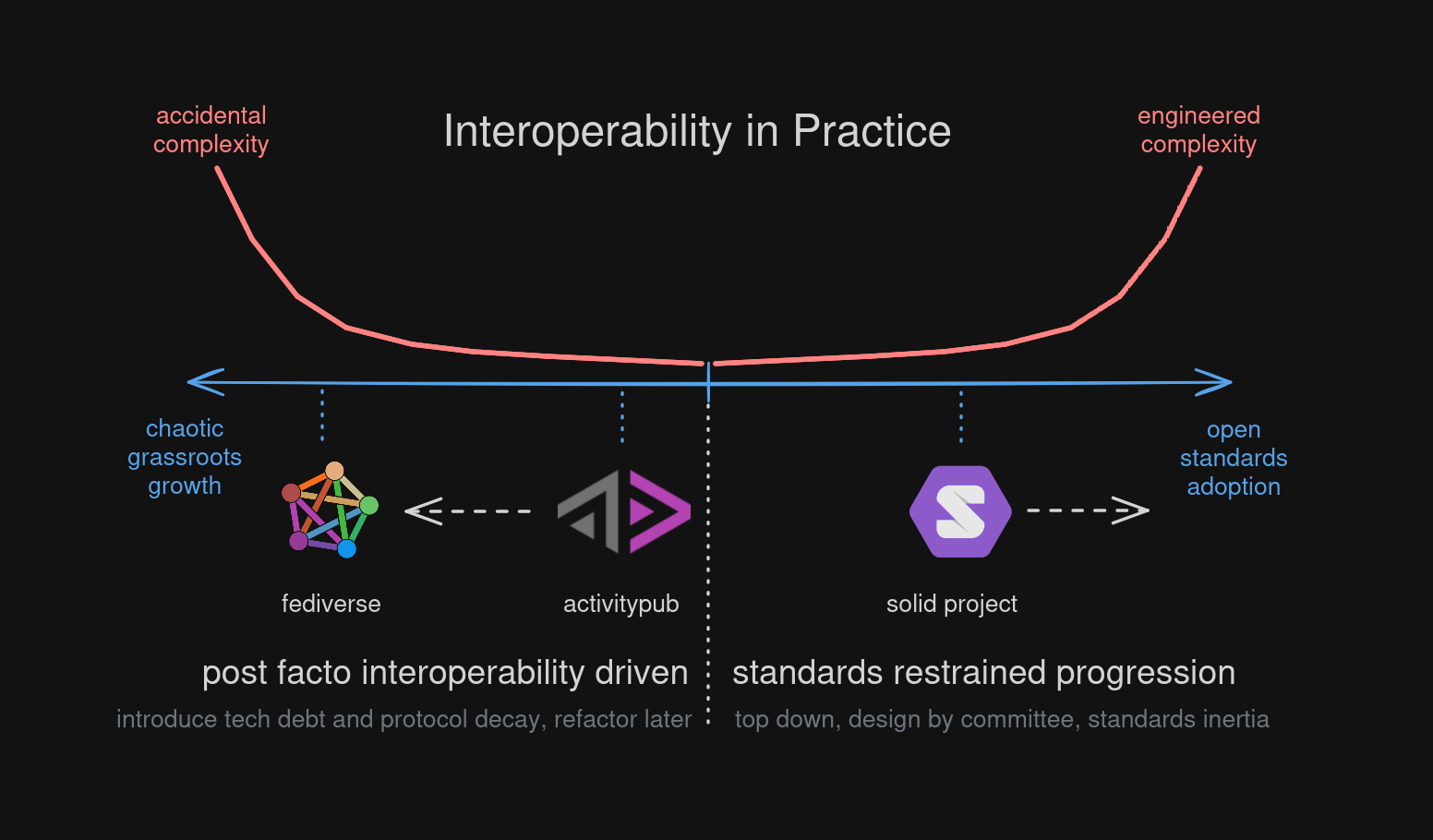
Diagram. Interoperability in practice. A chart with a horizontal axis that goes in 2 directions. On the left it moves towards chaotic grassroots growth, and on the right side towards open standards adoption. The Y-axis indicates level of complexity. The center indicates a low level of complexity.

On the left side of the axis we first find the ActivityPub open standard, with a relatively low complexity level. However the prevailing method to evolving the ecosystem is driven by post facto interoperability, where tech debt and protocol decay is introduced and accepted, which must be refactored and evolve alongside the open standard. Since this doesn鈥檛 happen, the fediverse grassroots environment is shifting more to the left into non-lineary increasing accidental complexity. Deviating more and more from the ActivityPub standard and the promise that it holds to offer the Future of Social networking.

On the right side, to contrast against fediverse, we find the Solid Project led by Sir Tim Berners-Lee, which is based on a whole range of W3C Linked Data related open standards and draft documents. There is no grassroots movement that drives progress, but a steering committee. Progress is restrained by open standards adoption and support. Higher levels of interoperability require more rigour and formal standardization, and this also leads to non-linear growth of, in this case, engineered complexity. Solution developers have to wait for many standards to mature, leading to inertia.
Diagram. Interoperability in practice. A chart with a horizontal axis that goes in 2 directions. On the left it moves towards chaotic grassroots growth, and on the right side towards open standards adoption. The Y-axis indicates level of complexity. The center indicates a low level of complexity. On the left side of the axis we first find the ActivityPub open standard, with a relatively low complexity level. However the prevailing method to evolving the ecosystem is driven by post facto interoperability, where tech debt and protocol decay is introduced and accepted, which must be refactored and evolve alongside the open standard. Since this doesn鈥檛 happen, the fediverse grassroots environment is shifting more to the left into non-lineary increasing accidental complexity. Deviating more and more from the ActivityPub standard and the promise that it holds to offer the Future of Social networking. On the right side, to contrast against fediverse, we find the Solid Project led by Sir Tim Berners-Lee, which is based on a whole range of W3C Linked Data related open standards and draft documents. There is no grassroots movement that drives progress, but a steering committee. Progress is restrained by open standards adoption and support. Higher levels of interoperability require more rigour and formal standardization, and this also leads to non-linear growth of, in this case, engineered complexity. Solution developers have to wait for many standards to mature, leading to inertia.
  • Copy link
  • Flag this comment
  • Block
Platform for Social Apps boosted
馃 Social coding commons
@smallcircles@social.coop  路  activity timestamp 6 days ago

@ben wrote a good article "Growing the open social web" for FediForum.

It poses this *essential* question: Why do we want to grow the open social web and for whom?

While the question is crucial when considering the future of social networking and the role of online technologies in society, it is not a question that is being addressed in any significant way. Our social web and fediverse "just happens", emerging from this chaotic cauldron of mostly technical discussions about which features to put in apps, how to connect one app to the next, and which social web technology or app is better than others.

Ben makes an appeal for creating good protocols, where the real value is, but only if we can share ownership of them. I 100% agree with the points in the article.

But how do we get there? What is this ownership? How do we achieve it, and subsequently retain it? I wrote down some some thoughts in a blog post.

https://coding.social/blog/shared-ownership/

#SX #SocialCoding #SocialWeb #fediverse #ActivityPub

Social coding commons

Shared responsible social web ownership

We strive for an inclusive social web that is by the people and for the people. But how do we guarantee equity and shared ownership?
  • Copy link
  • Flag this post
  • Block
馃 Social coding commons
@smallcircles@social.coop  路  activity timestamp 6 days ago

@ben wrote a good article "Growing the open social web" for FediForum.

It poses this *essential* question: Why do we want to grow the open social web and for whom?

While the question is crucial when considering the future of social networking and the role of online technologies in society, it is not a question that is being addressed in any significant way. Our social web and fediverse "just happens", emerging from this chaotic cauldron of mostly technical discussions about which features to put in apps, how to connect one app to the next, and which social web technology or app is better than others.

Ben makes an appeal for creating good protocols, where the real value is, but only if we can share ownership of them. I 100% agree with the points in the article.

But how do we get there? What is this ownership? How do we achieve it, and subsequently retain it? I wrote down some some thoughts in a blog post.

https://coding.social/blog/shared-ownership/

#SX #SocialCoding #SocialWeb #fediverse #ActivityPub

Social coding commons

Shared responsible social web ownership

We strive for an inclusive social web that is by the people and for the people. But how do we guarantee equity and shared ownership?
  • Copy link
  • Flag this post
  • Block

BT Free Social

BT Free is a non-profit organization founded by @ozoned@btfree.social . It's goal is for digital privacy rights, advocacy and consulting. This goal will be attained by hosting open platforms to allow others to seamlessly join the Fediverse on moderated instances or by helping others join the Fediverse.

BT Free Social: About 路 Code of conduct 路 Privacy 路
Bonfire social 路 1.0.2-alpha.34 no JS en
Automatic federation enabled
Log in
Instance logo
  • Explore
  • About
  • Code of Conduct