Discussion
Loading...

Post

Log in
  • About
  • Code of conduct
  • Privacy
  • About Bonfire
🫧 Social coding commons
@smallcircles@social.coop  ·  activity timestamp 3 days ago

#ThoughtProvoker blobhyperthink

The current fediverse is an evolutionary dead-end for 2 reasons:

1. It has painted itself in a small niche of decentralizing typical social media use cases, by means of post-facto interop and the introduction of protocol decay.

2. Lacking a proper grassroots standardization process, and with the primary mechanism for fediverse extension being only post-facto interoperability, there is no way out.

Congratulations to the early adopters, who managed to "cross the chasm" with their own app platforms. It took true grit to become deep #ActivityPub experts, and plug holes needed for your app, but you have made it. Post-facto interop works in your favor now. You are unrestrained to productively add more features in your app, and put them on the fedi wire for others to deal with.

To avoid fedi to become less and less attractive to newcomers, we must now consider:

“Why do we want to grow the open social web, and for whom?” -- @ben

http://coding.social/blog/shared-ownership/

Social coding commons

Shared responsible social web ownership

We strive for an inclusive social web that is by the people and for the people. But how do we guarantee equity and shared ownership?
  • Copy link
  • Flag this post
  • Block
🫧 Social coding commons
@smallcircles@social.coop  ·  activity timestamp 2 days ago

Quoting from another toot I just posted:

> What I am talking about is architecture and design, and all the things that allow people to easily form a clear mental picture on how things fit together, wrap their head around the fediverse.

> Never defining this well, and having the documentation be scattered all across the fediverse in 1,001 random locations doesn't help. Meanwhile the dev talk that is going on for years remains very inefficient due to endless Babylonian speech confusion.

Another quote has steps that would then be involved with solution design, and expand fedi's interoperable apps & services:

https://social.coop/@smallcircles/116109322688804011

Without that, with app-centric protocol-decay-ensuring method we have:

0. Deteriorate your domain, reduce ambition
1. Hammer your design until it looks like a microblog, add warts for own features
2. Plug and pray that it works
3. Keep fixing based on daily fedi weather conditions
--
4. Discuss fixes in fire-and-forget fleety communication channels

@ben

  • Copy link
  • Flag this comment
  • Block
🫧 Social coding commons
@smallcircles@social.coop  ·  activity timestamp 2 days ago

To chain things together a bit on this fleety medium of ours, create a hyperweb 😜 I'll quote this toot to follow-up to

https://social.coop/@smallcircles/116110545919004233

I remember about 2018 or so, when I joined my first #SocialCG meetup. It was when the CG was still strongly tied to #SocialHub community.

There were mundane items on the agenda, interesting to any #ActivityPub dev, and also the call to action was "whether you are technical or not at all, join the meetup, we are open and inclusive to all fedizens". Very friendly, good vibes.

However during the session the talk was not only CS expert level, but dealing with subject matter nowhere near the spec. It was 'wire reality' slang, and to learn it the guidance was either nowhere, or everywhere, dispersed. And this is still as it is today. To expertised AP developers their domain language sounds all natural, but it likely seems Martian to a dev newcomer.

Stark contrast to the W3C specs that leave folks with refreshing "Let's implement this" vibe.

@ben

  • Copy link
  • Flag this comment
  • Block
🫧 Social coding commons
@smallcircles@social.coop  ·  activity timestamp 2 days ago

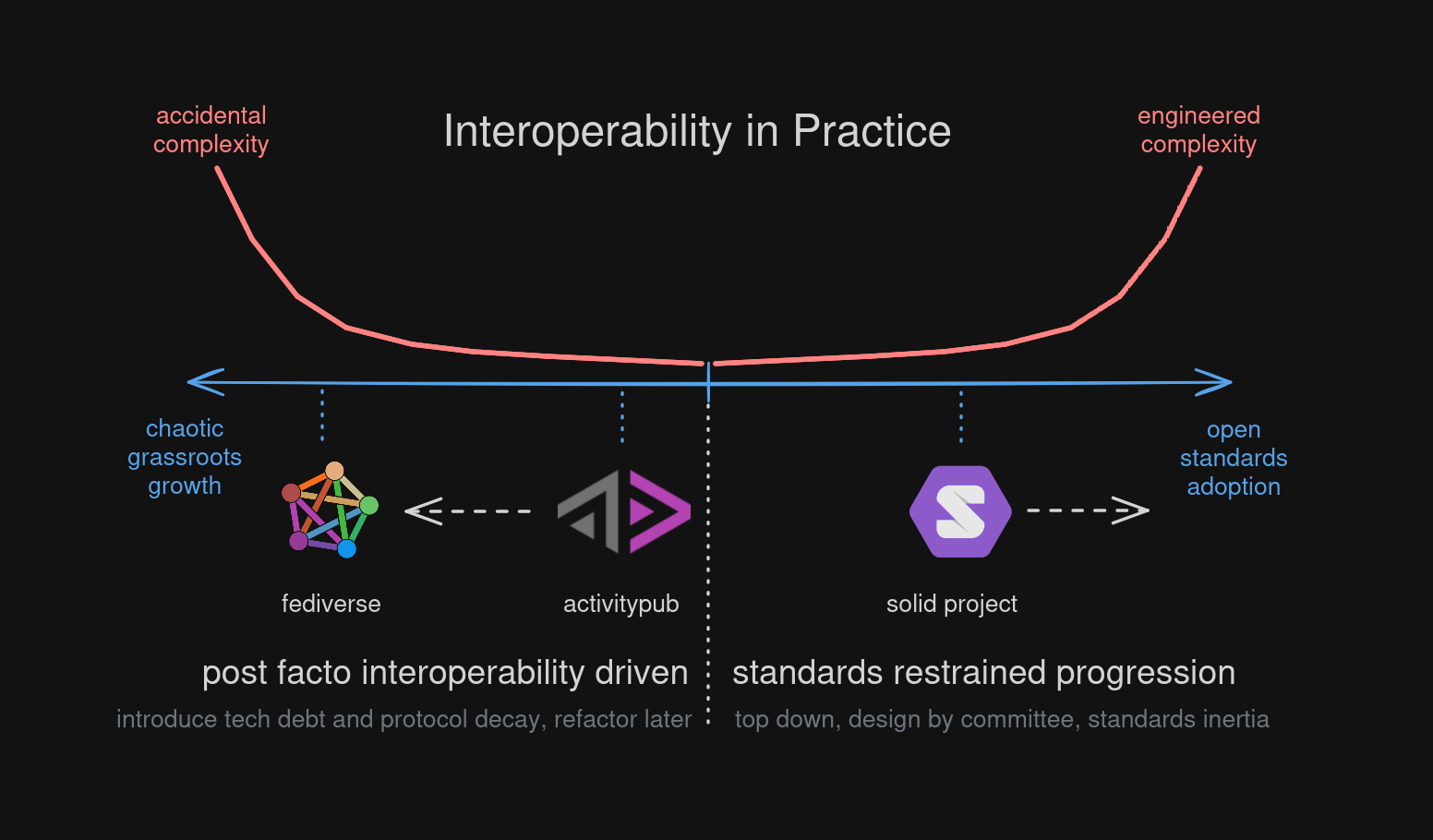
I recreated an old diagram in Excalidraw that I spread about a couple years ago, and made it a bit more informative. Explanation can be found in the #AltText

See also and for discussion: https://discuss.coding.social/t/diagram-interoperability-in-practice/828

Or join the Social experience design chatroom at: https://matrix.to/#/#socialcoding-foundations:matrix.org

Also posted to #SocialHub at: https://socialhub.activitypub.rocks/t/activitypub-versus-fediverse-interoperability-in-practice/8498

@ben

#SX #SocialCoding #SocialWeb #ActivityPub #SolidProject #fediverse

Diagram. Interoperability in practice. A chart with a horizontal axis that goes in 2 directions. On the left it moves towards chaotic grassroots growth, and on the right side towards open standards adoption. The Y-axis indicates level of complexity. The center indicates a low level of complexity.

On the left side of the axis we first find the ActivityPub open standard, with a relatively low complexity level. However the prevailing method to evolving the ecosystem is driven by post facto interoperability, where tech debt and protocol decay is introduced and accepted, which must be refactored and evolve alongside the open standard. Since this doesn’t happen, the fediverse grassroots environment is shifting more to the left into non-lineary increasing accidental complexity. Deviating more and more from the ActivityPub standard and the promise that it holds to offer the Future of Social networking.

On the right side, to contrast against fediverse, we find the Solid Project led by Sir Tim Berners-Lee, which is based on a whole range of W3C Linked Data related open standards and draft documents. There is no grassroots movement that drives progress, but a steering committee. Progress is restrained by open standards adoption and support. Higher levels of interoperability require more rigour and formal standardization, and this also leads to non-linear growth of, in this case, engineered complexity. Solution developers have to wait for many standards to mature, leading to inertia.
Diagram. Interoperability in practice. A chart with a horizontal axis that goes in 2 directions. On the left it moves towards chaotic grassroots growth, and on the right side towards open standards adoption. The Y-axis indicates level of complexity. The center indicates a low level of complexity. On the left side of the axis we first find the ActivityPub open standard, with a relatively low complexity level. However the prevailing method to evolving the ecosystem is driven by post facto interoperability, where tech debt and protocol decay is introduced and accepted, which must be refactored and evolve alongside the open standard. Since this doesn’t happen, the fediverse grassroots environment is shifting more to the left into non-lineary increasing accidental complexity. Deviating more and more from the ActivityPub standard and the promise that it holds to offer the Future of Social networking. On the right side, to contrast against fediverse, we find the Solid Project led by Sir Tim Berners-Lee, which is based on a whole range of W3C Linked Data related open standards and draft documents. There is no grassroots movement that drives progress, but a steering committee. Progress is restrained by open standards adoption and support. Higher levels of interoperability require more rigour and formal standardization, and this also leads to non-linear growth of, in this case, engineered complexity. Solution developers have to wait for many standards to mature, leading to inertia.
  • Copy link
  • Flag this comment
  • Block
🫧 Social coding commons
@smallcircles@social.coop  ·  activity timestamp 17 hours ago

https://social.coop/@smallcircles/116119514853649098

To get back to 'shared ownership' and @ben article that triggered my blog post.

The #fediverse is certainly not all cheerleaders, but the question is whether critical notes can be properly heard and addressed in any meaningful way. After all who are the ones who should hear them and act on them? It is "the herd", the crowd, the commons that happens to receive toots via their social graph, and to the extent these manage to penetrate bubbles and echo chambers. To make a strong argument, to reach people, the only strategy is social media influence marketing of sorts. You have to dare to rock the boat enough to be heard. And that's a very bad way to grow a healthy ecosystem I think.

It relates to the oft-heared criticism that on the app-centric #ActivityPub fediverse, it is the app devs who are de-facto in charge and decide what goes and what goes not.

The social dynamics are tricky but fascinating. I hope to be able to spend more time at https://coding.social

  • Copy link
  • Flag this comment
  • Block
jon ⚝
jon ⚝
@yala@degrowth.social  ·  activity timestamp 2 days ago

@smallcircles
I remember this sentence from https://ufind.univie.ac.at/de/person.html?id=1001662, around 2013:
"Interoperability can only be proven after the fact."
@ben

  • Copy link
  • Flag this comment
  • Block

BT Free Social

BT Free is a non-profit organization founded by @ozoned@btfree.social . It's goal is for digital privacy rights, advocacy and consulting. This goal will be attained by hosting open platforms to allow others to seamlessly join the Fediverse on moderated instances or by helping others join the Fediverse.

BT Free Social: About · Code of conduct · Privacy ·
Bonfire social · 1.0.2-alpha.34 no JS en
Automatic federation enabled
Log in
Instance logo
  • Explore
  • About
  • Code of Conduct