
Discussion
Loading...

#Tag

Log in
  • About
  • Code of conduct
  • Privacy
  • About Bonfire
@reiver ⊼ (Charles) :batman:
@reiver@mastodon.social  ·  activity timestamp yesterday

@thisismissem @mfru

In your opinion, did you feel that the complexity of Solid was ONLY due to JSON-LD?

Or, were there other (non- JSON-LD) things that made it complex, too?

🫧 Social coding commons
@smallcircles@social.coop  ·  activity timestamp 19 hours ago

@reiver @thisismissem @mfru

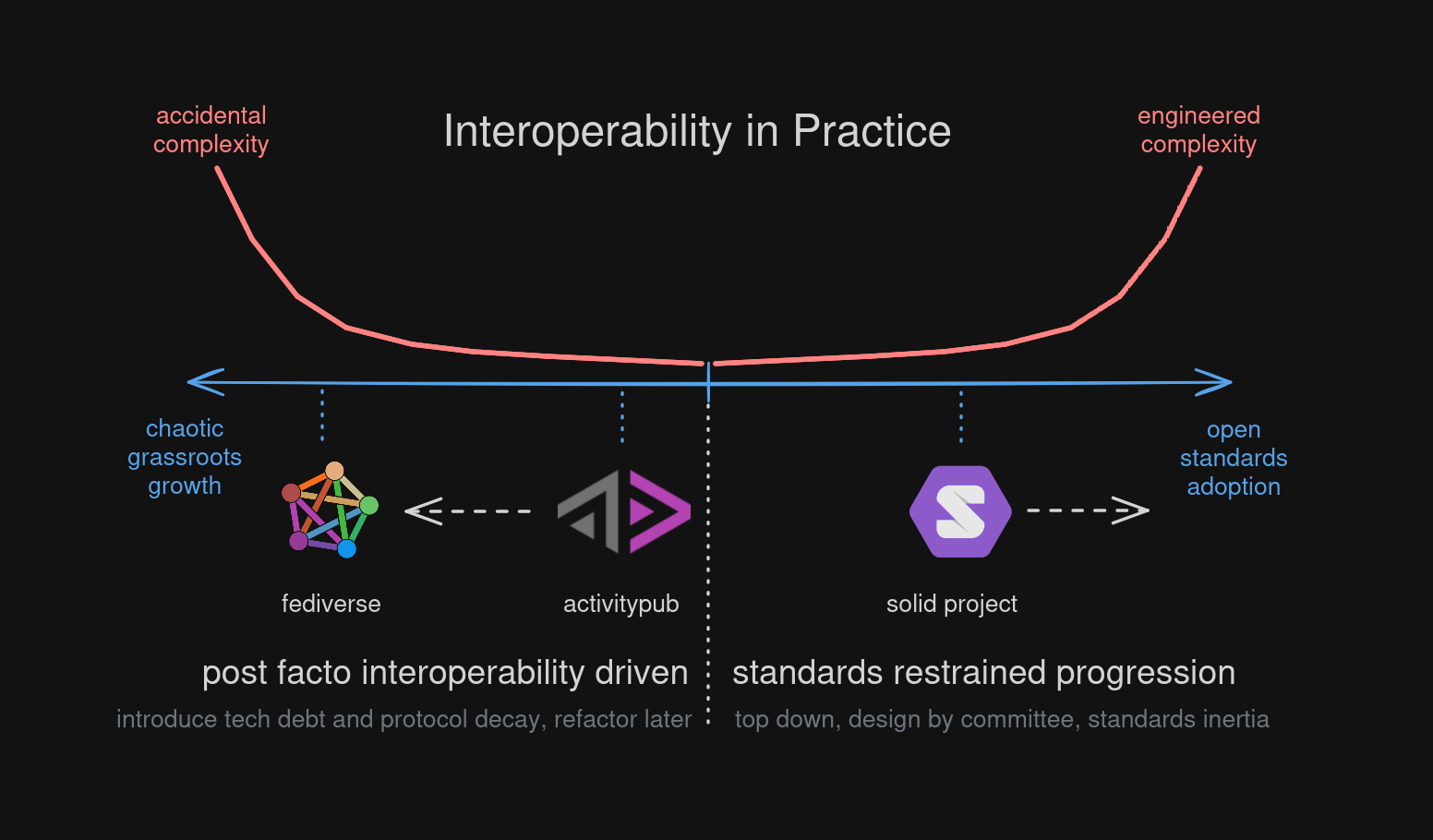
I made a diagram yesterday that contrasts #ActivityPub and #SolidProject that is I think interesting to consider.

In the past I've been very active on the Solid forum, and tried to get a collab going with #SocialHub community. A number of points that existed then, are still issues today I think.

Like, though anyone could participate in the standards process via chat, the Solid team and Inrupt were not really interested in their community, hardly giving attention while people were building interesting stuff there.

Also at the time basically all available code was Javascript, making Solid uninteresting or hard to access for other language devs.

But I think biggest issue was that Solid didn't know what it was. It was positioned as 'personal data vault' on the landing page then (but not using this term), but was 'secretly' TBL's desire to reboot the #SemanticWeb. The new web would be all 'Solid apps'. But the adoption strategy for that didn't exist.

  • Copy link
  • Flag this comment
  • Block
🫧 Social coding commons
@smallcircles@social.coop  ·  activity timestamp 2 days ago

@david_megginson @ben

Yes, I agree. Though the diagram is too simple to capture it well, it is important to identify the forces that are at play, and the mechanics that drive them, and to subsequently monitor where you are and where you want to be in the future. So timely action can be taken to make corrective actions.

For the #SolidProject ecosystem for instance they might have identified a minimum set of standards to adopt, with which reasonably powerful "MVP's of the Semantic web" could be approximated with. And focus on strong library and tool support for that in multiple programming environments. Instead you enter a jungle of open stardards in various stages of completion, and good luck go figure it out. Also they might've focused on actual movement building. Far-reaching innovative standards - a new paradigm for the web - aren't adopted by the boardroom of a company, but are introduced by devs who get excited by what see and how they are empowered. And persuade management.

🫧 Social coding commons
@smallcircles@social.coop  ·  activity timestamp 2 days ago

@david_megginson @ben

Though with regards to progress, there's a difference in both approaches.

At the #SolidProject side you have inertia by the slow standardization process. But should they figure things out in a good way, eventually the ecosystem catches up and the inertia can quickly decrease.

While at #ActivityPub side, since AS/AP remains stagnant, the ever increasing protocol decay and tech debt non-linearly increases inertia and progress. And on top of that, you are never done once you implemented the 'ad-hoc specs' of the installed base, and you have to account for continuous whack-a-mole development and maintenance burdens to fix #interoperability breakages.

The AS/AP based fediverse devolves into effectively no interoperability, and a situation that is more comporative to NPM dependency hell.

  • Copy link
  • Flag this comment
  • Block
David Megginson
David Megginson
@david_megginson@mstdn.ca  ·  activity timestamp 2 days ago

@smallcircles @ben The interesting thing is that it's not really a trade-off at all.

The right side of the diagram almost never works in practice — unless there's a dominant player who can enforce strict compliance, like Walmart for a supply chain or the U.S. government for corporate filings — so it's typically a choice between messiness or failure, not between messiness or slow progress.

#standards

🫧 Social coding commons
@smallcircles@social.coop  ·  activity timestamp 2 days ago

@david_megginson @ben

Yes, I agree. Though the diagram is too simple to capture it well, it is important to identify the forces that are at play, and the mechanics that drive them, and to subsequently monitor where you are and where you want to be in the future. So timely action can be taken to make corrective actions.

For the #SolidProject ecosystem for instance they might have identified a minimum set of standards to adopt, with which reasonably powerful "MVP's of the Semantic web" could be approximated with. And focus on strong library and tool support for that in multiple programming environments. Instead you enter a jungle of open stardards in various stages of completion, and good luck go figure it out. Also they might've focused on actual movement building. Far-reaching innovative standards - a new paradigm for the web - aren't adopted by the boardroom of a company, but are introduced by devs who get excited by what see and how they are empowered. And persuade management.

  • Copy link
  • Flag this comment
  • Block
🫧 Social coding commons
@smallcircles@social.coop  ·  activity timestamp 2 days ago

To chain things together a bit on this fleety medium of ours, create a hyperweb 😜 I'll quote this toot to follow-up to

https://social.coop/@smallcircles/116110545919004233

I remember about 2018 or so, when I joined my first #SocialCG meetup. It was when the CG was still strongly tied to #SocialHub community.

There were mundane items on the agenda, interesting to any #ActivityPub dev, and also the call to action was "whether you are technical or not at all, join the meetup, we are open and inclusive to all fedizens". Very friendly, good vibes.

However during the session the talk was not only CS expert level, but dealing with subject matter nowhere near the spec. It was 'wire reality' slang, and to learn it the guidance was either nowhere, or everywhere, dispersed. And this is still as it is today. To expertised AP developers their domain language sounds all natural, but it likely seems Martian to a dev newcomer.

Stark contrast to the W3C specs that leave folks with refreshing "Let's implement this" vibe.

@ben

🫧 Social coding commons
@smallcircles@social.coop  ·  activity timestamp 2 days ago

I recreated an old diagram in Excalidraw that I spread about a couple years ago, and made it a bit more informative. Explanation can be found in the #AltText

See also and for discussion: https://discuss.coding.social/t/diagram-interoperability-in-practice/828

Or join the Social experience design chatroom at: https://matrix.to/#/#socialcoding-foundations:matrix.org

Also posted to #SocialHub at: https://socialhub.activitypub.rocks/t/activitypub-versus-fediverse-interoperability-in-practice/8498

@ben

#SX #SocialCoding #SocialWeb #ActivityPub #SolidProject #fediverse

Diagram. Interoperability in practice. A chart with a horizontal axis that goes in 2 directions. On the left it moves towards chaotic grassroots growth, and on the right side towards open standards adoption. The Y-axis indicates level of complexity. The center indicates a low level of complexity.

On the left side of the axis we first find the ActivityPub open standard, with a relatively low complexity level. However the prevailing method to evolving the ecosystem is driven by post facto interoperability, where tech debt and protocol decay is introduced and accepted, which must be refactored and evolve alongside the open standard. Since this doesn’t happen, the fediverse grassroots environment is shifting more to the left into non-lineary increasing accidental complexity. Deviating more and more from the ActivityPub standard and the promise that it holds to offer the Future of Social networking.

On the right side, to contrast against fediverse, we find the Solid Project led by Sir Tim Berners-Lee, which is based on a whole range of W3C Linked Data related open standards and draft documents. There is no grassroots movement that drives progress, but a steering committee. Progress is restrained by open standards adoption and support. Higher levels of interoperability require more rigour and formal standardization, and this also leads to non-linear growth of, in this case, engineered complexity. Solution developers have to wait for many standards to mature, leading to inertia.
Diagram. Interoperability in practice. A chart with a horizontal axis that goes in 2 directions. On the left it moves towards chaotic grassroots growth, and on the right side towards open standards adoption. The Y-axis indicates level of complexity. The center indicates a low level of complexity. On the left side of the axis we first find the ActivityPub open standard, with a relatively low complexity level. However the prevailing method to evolving the ecosystem is driven by post facto interoperability, where tech debt and protocol decay is introduced and accepted, which must be refactored and evolve alongside the open standard. Since this doesn’t happen, the fediverse grassroots environment is shifting more to the left into non-lineary increasing accidental complexity. Deviating more and more from the ActivityPub standard and the promise that it holds to offer the Future of Social networking. On the right side, to contrast against fediverse, we find the Solid Project led by Sir Tim Berners-Lee, which is based on a whole range of W3C Linked Data related open standards and draft documents. There is no grassroots movement that drives progress, but a steering committee. Progress is restrained by open standards adoption and support. Higher levels of interoperability require more rigour and formal standardization, and this also leads to non-linear growth of, in this case, engineered complexity. Solution developers have to wait for many standards to mature, leading to inertia.
  • Copy link
  • Flag this comment
  • Block

BT Free Social

BT Free is a non-profit organization founded by @ozoned@btfree.social . It's goal is for digital privacy rights, advocacy and consulting. This goal will be attained by hosting open platforms to allow others to seamlessly join the Fediverse on moderated instances or by helping others join the Fediverse.

BT Free Social: About · Code of conduct · Privacy ·
Bonfire social · 1.0.2-alpha.34 no JS en
Automatic federation enabled
Log in
Instance logo
  • Explore
  • About
  • Code of Conduct