🚨🚨🚨 We're in midst of a massive, direct hit geomagnetic storm right now...
"Storms of this magnitude can disrupt satellite operations, degrade GPS navigation and increase atmospheric drag on spacecraft. They can also supercharge auroral activity..."
🚨🚨🚨 We're in midst of a massive, direct hit geomagnetic storm right now...
"Storms of this magnitude can disrupt satellite operations, degrade GPS navigation and increase atmospheric drag on spacecraft. They can also supercharge auroral activity..."
🚨🚨🚨 We're in midst of a massive, direct hit geomagnetic storm right now...
"Storms of this magnitude can disrupt satellite operations, degrade GPS navigation and increase atmospheric drag on spacecraft. They can also supercharge auroral activity..."
👀
G4 (Severe) Geomagnetic Storm Watch for 20 January UTC-Day
published: Monday, January 19, 2026 15:37 UTC
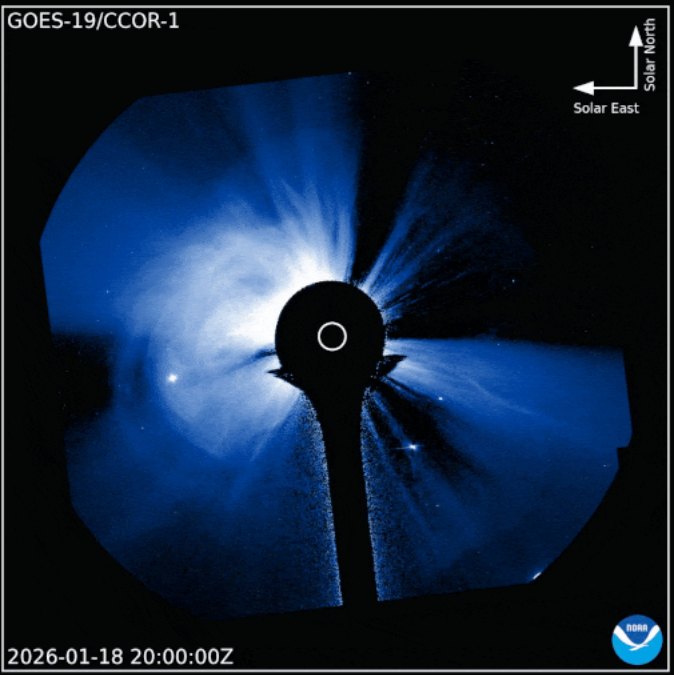
A G4 (Severe) geomagnetic storm watch is in effect for the 20 January UTC-day due to Earth-arrival of a coronal mass ejection (CME). The CME blasted from the Sun on 18 Jan, in association with an energetic R3 (Strong) solar flare from a sunspot region near center-disk, and is anticipated to arrive at Earth as early as late 19 Jan EST to early 20 Jan. While the G4 Watch is out for the 20 Jan UTC-day, geomagnetic storm levels could range from G1-G3 (Minor-Moderate) upon CME arrival later on 19 Jan EST. CME passage is expected to continue through 20 Jan, but conditions are likely to weaken later in the day. G1 levels remain possible on 21 Jan due to residual CME related effects. Forecasters have a fair measure of confidence in timing and of CME arrival at Earth.
Sun releases the largest solar radiation storm ‘in over 20 years,’ forecasters say
By Ashley Strickland, January 19, 2026
"Powerful solar activity released by the sun is heading for Earth and it’s likely to create dazzling auroral displays in unexpected areas Monday evening and early Tuesday morning. It could also disrupt #satellite-based communications and #GPS accuracy.
"A solar radiation storm, ranked at a level four out of five on a severity scale, is being tracked by the National Weather Service’s Space Weather Prediction Center, or #SWPC.
" 'An #S4 severe #SolarRadiation storm is now in progress - this is the largest solar radiation storm in over 20 years,' SWPC shared on X, formerly known as Twitter. 'The last time S4 levels were observed was in October, 2003. Potential effects are mainly limited to space launch, aviation, and satellite operations.' "
Read more:
https://www.cnn.com/2026/01/19/science/largest-solar-radiation-storm-auroras
#SolarFlare #GeomagneticStorm #Satellites #KesslerSyndrome? #Starlink

Sun releases the largest solar radiation storm ‘in over 20 years,’ forecasters say
By Ashley Strickland, January 19, 2026
"Powerful solar activity released by the sun is heading for Earth and it’s likely to create dazzling auroral displays in unexpected areas Monday evening and early Tuesday morning. It could also disrupt #satellite-based communications and #GPS accuracy.
"A solar radiation storm, ranked at a level four out of five on a severity scale, is being tracked by the National Weather Service’s Space Weather Prediction Center, or #SWPC.
" 'An #S4 severe #SolarRadiation storm is now in progress - this is the largest solar radiation storm in over 20 years,' SWPC shared on X, formerly known as Twitter. 'The last time S4 levels were observed was in October, 2003. Potential effects are mainly limited to space launch, aviation, and satellite operations.' "
Read more:
https://www.cnn.com/2026/01/19/science/largest-solar-radiation-storm-auroras
#SolarFlare #GeomagneticStorm #Satellites #KesslerSyndrome? #Starlink

A solar proton storm (S3) is already in progress after a powerful X-class solar flare. Now NOAA warns a SEVERE G4 geomagnetic storm is possible the night of Jan 19–20, when a CME from an X1.9 long-duration flare hits Earth. Aurora may be visible across northern U.S. states—and camera-visible color could reach as far south as AZ, TX & SoCal. Charge phones and look north! https://spaceweather.com/
#SolarStorm #AuroraAlert #SpaceWeather #GeomagneticStorm #CME #SolarFlare
A solar proton storm (S3) is already in progress after a powerful X-class solar flare. Now NOAA warns a SEVERE G4 geomagnetic storm is possible the night of Jan 19–20, when a CME from an X1.9 long-duration flare hits Earth. Aurora may be visible across northern U.S. states—and camera-visible color could reach as far south as AZ, TX & SoCal. Charge phones and look north! https://spaceweather.com/
#SolarStorm #AuroraAlert #SpaceWeather #GeomagneticStorm #CME #SolarFlare
👀
G4 (Severe) Geomagnetic Storm Watch for 20 January UTC-Day
published: Monday, January 19, 2026 15:37 UTC
A G4 (Severe) geomagnetic storm watch is in effect for the 20 January UTC-day due to Earth-arrival of a coronal mass ejection (CME). The CME blasted from the Sun on 18 Jan, in association with an energetic R3 (Strong) solar flare from a sunspot region near center-disk, and is anticipated to arrive at Earth as early as late 19 Jan EST to early 20 Jan. While the G4 Watch is out for the 20 Jan UTC-day, geomagnetic storm levels could range from G1-G3 (Minor-Moderate) upon CME arrival later on 19 Jan EST. CME passage is expected to continue through 20 Jan, but conditions are likely to weaken later in the day. G1 levels remain possible on 21 Jan due to residual CME related effects. Forecasters have a fair measure of confidence in timing and of CME arrival at Earth.