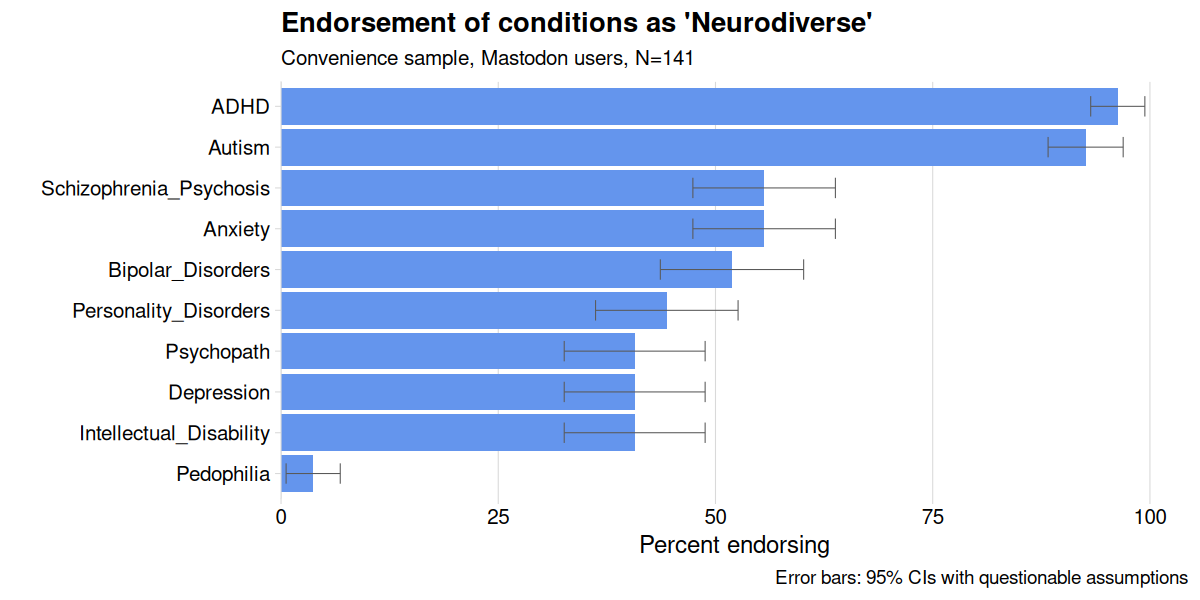
I did a poll here for a week. 141 people responded. I was interested in #mastodon users' preferred categorization of the term "neurodiverse." The results generally confirmed my a priori predictions but had some surprises. Some takeaways for me, right now:
- Autism was in a tie for top position, unsurprising as, in my experience, autism was the first condition to be labeled "neurodiverse" or "neuroatypical", and is, I suspect, something of a prototype for the category.
- ADHD was tied (given the sample) with autism. I was mildly surprised. I think a few years ago this would not have been the case; ADHD awareness, activism, and acceptance have increased dramatically over the past few years.
- Schizophrenia, anxiety disorders, and #bipolar disorders were the next group. The inclusion of anxiety disorders surprised me; I suspected it would be tied with depression disorders.
- Personality disorders being endorsed at the same rate as depression and intellectual disability was a mild surprise.
- Psychopathy being tied with depression and intellectual disability was a pretty big surprise for me. This poll was largely about opinions and preferences, so stigma is (IMO) a big part of it. "Being a psychohpath" seems to be less stigmatized (in a specific way) than I thought... it's also possible the results would change if I'd used the word "psychopath" instead of "psychopathy."
- Intellectual disabiity (until pretty recently labeled "mental retardation" but, you know, the euphemism treadmill) was a wild card for me; I didn't know where it would end up. I would like to do a different survey sometime, with a different response format, so I could see the variability in responses. I suspect this condition (and a few others) would result in a lot of variability.
- Pedophilia was of particular interest to me. The results confirmed my strong a priori hypothesis, and this (plus psychopathy) was a major reason for wording the poll as I did, prompoting for preferences instead of a more objective assessment of the research-based fitness of each condition for the "neurodiverse" category.
More about #pedophilia: a nice, big mountain of research strongly suggests that it is a condition of altered brain development; in fact, it is probably a sexual orientation. A better survey than this simple poll might assess participants' understanding of pedophilia in addition to the question I did ask. I suspect many people confuse pedophilia with child molestation/abuse (nb: pedophilia is a pattern of attraction, not a set of behaviors, though many pedophiles have also abused children).
Both the left and right political meta-groups in the USA have latched onto "pedophile" as a label for child molestation--usually of post-pubescent children, where pedophilia is very specifically a pattern of attraction to prepubescent children. There was flirtation during Trump's first term with the more correct(ish) labels "hebephilia" and "ephebephilia", but I think the need for a stronger, more dehumanizing label won in the end, and "pedophile" packs a bigger cultural/emotional punch than "child molester."
Anyway, thanks to everyone who participated. This is fascinating enough for me that I might even do a real survey sometime. If I can get my dean to stop giving me extra classes for calling him out on his anti-labor nonsense.
Notes:
- I phrased the question as *Which of the following conditions do you personally think should be included under the #neurodiversity umbrella? * instead of asking which conditions would be classified as neurodiverse, etc. for reasons noted above.
- I chose "neurodiverse" instead of "neuroatypical", believing that the latter would produce more restricted categorization.
- This is not (I hope) research according to federal definitions. It's a demonstration of a concept and I won't be trying to disseminate these results in scientific journals or at science conferences.
#neurodiverse #neuroatypical #poll #adhd #autism #schizophrenia #anxiety #bipolar #PersonalityDisorder #psychopathy #depression #IntellectualDisability